Dixon's sales jumped 47%, but costly chips shrank the profit on each rupee
India's biggest contract electronics maker and rival Syrma SGS both grew fast from July to September, while memory chip prices squeezed margins.

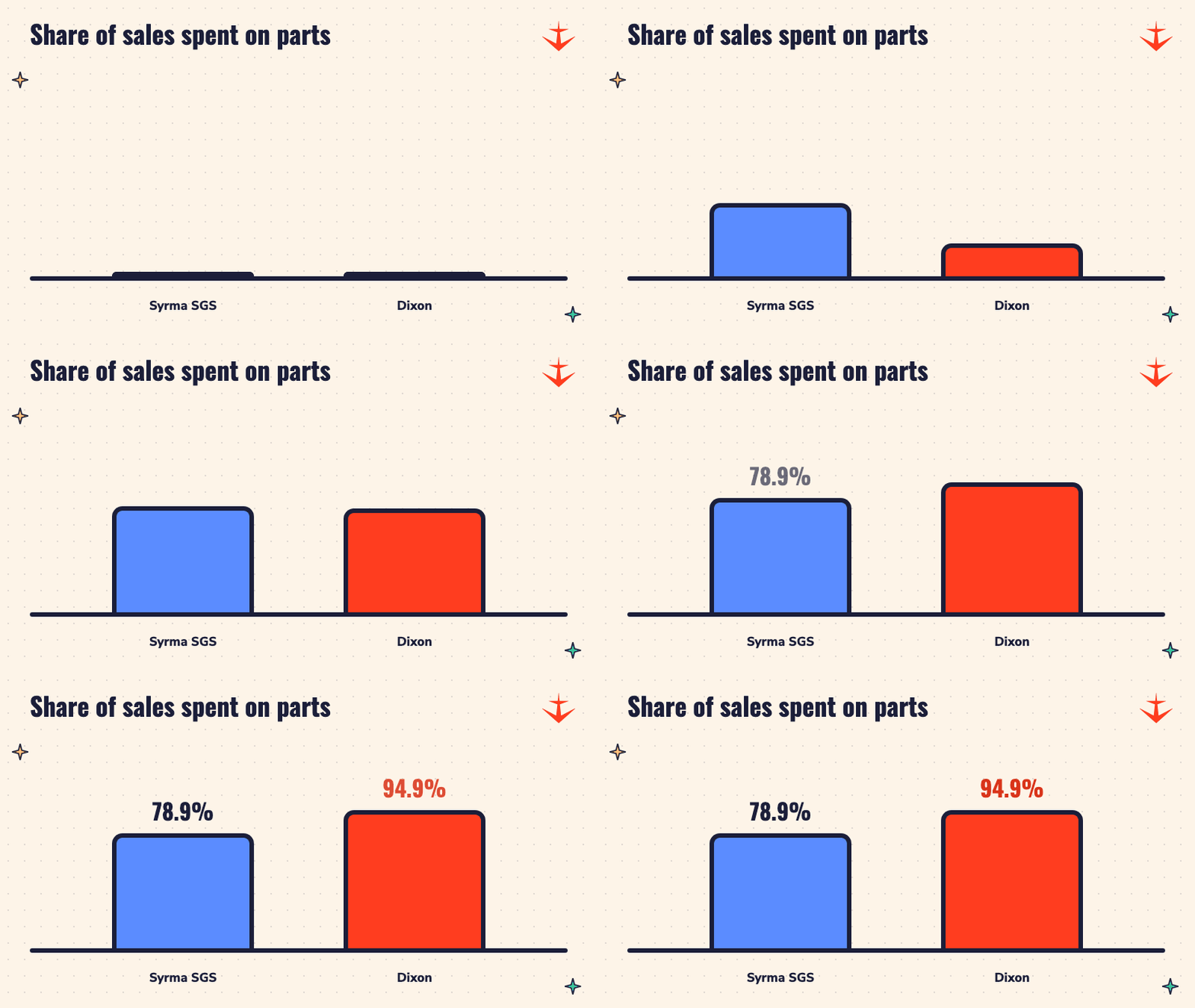
Picture a kitchen that cooks for many famous restaurant brands. Orders keep pouring in, but one key ingredient now costs far more. That is roughly the story of Dixon Technologies right now. In the three months from July to September 2026, this Noida company spent about 94.9% of its revenue on materials, mostly electronic parts. Out of every Rs 100 it earned, only a few rupees were left after paying for parts.
Dixon and a smaller rival, Syrma SGS, both shared their results on Friday, 30 October 2026, after the market closed. Both sold far more than a year ago. Both said parts, especially chips, now cost more.
First, what does Dixon actually make?
Dixon is a contract manufacturer. That means it builds products that carry another company's name. Think of a cloud kitchen that cooks biryani for five different food apps. You order from the app, but the same kitchen made your food.
According to Wikipedia, Dixon was founded in 1993 by Sunil Vachani and makes televisions, washing machines, smartphones, LED lights and CCTV security systems for brands including Samsung, Xiaomi, Panasonic and Philips. It has 17 factories in India.
Phones are now the biggest part of the business. Dixon's mobile and electronics manufacturing division made up 92% of sales this quarter and grew 50% to Rs 20,093 crore.
This video explains how one Indian company quietly builds products for big global brands.
Sales jumped. So why did profit fall?
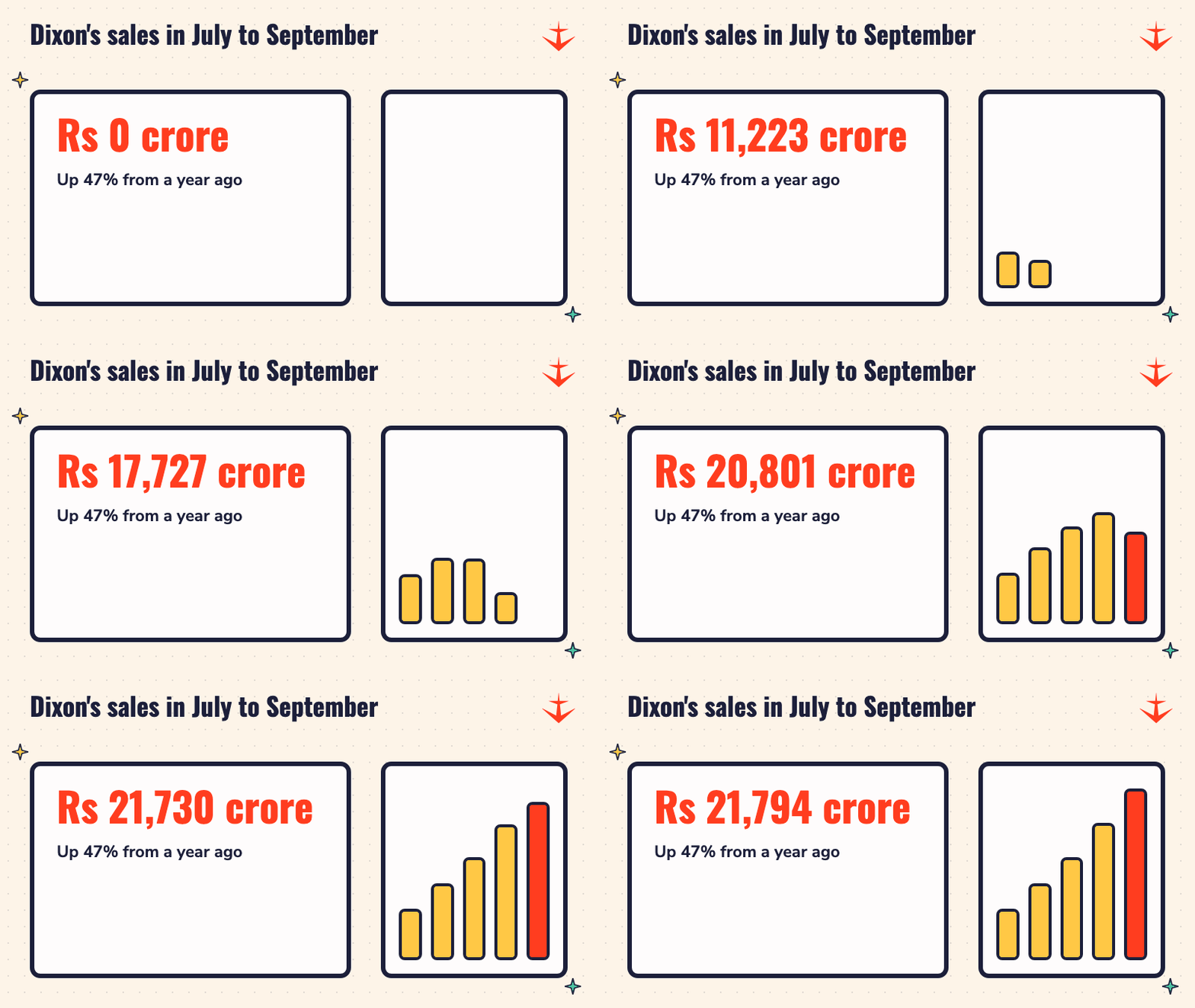
Dixon's revenue, the total money it earned from selling, rose 47% to Rs 21,794 crore compared with July to September 2025.
But the company's profit after tax fell 45% to about Rs 411 crore. The company's filing, summarised by Multibagg, puts the exact figure at Rs 410.87 crore, down from Rs 745.70 crore a year earlier. These are consolidated numbers, which means the whole group added together.
The fall is mostly about a one-time gain. Dixon owns a stake in another company, Aditya Infotech. When the value of that stake goes up, Dixon can count the rise as profit, even though no cash came in. Think of a rare cricket card in your drawer. If its price goes up, you are richer on paper, but you have not sold it.
A year ago, this paper gain was Rs 465 crore. This time it was only Rs 57 crore. Leaving out that gain and a Rs 28 crore profit from selling its lighting business last year, Dixon's adjusted profit rose 11% to Rs 360 crore.

The chip problem, explained with a samosa stall
Imagine you run a samosa stall. You sell each samosa for Rs 20. If potatoes and oil cost Rs 15, you keep Rs 5. That Rs 5 is your margin. Now oil prices jump and your costs become Rs 17. If you sell more samosas, your total sales go up, but you keep less on each one.
That is what happened at Dixon. Its operating margin, leaving out other income, dropped to 2.7% from 3.8%. In the phone division, the margin fell to 2.5% from 3.5%. The filing shows the cost of materials rose to Rs 20,679.03 crore, up from Rs 13,504.06 crore a year earlier.
Why are parts so costly? Memory chips are the big reason. These chips store your photos, apps and games. Tech giants such as Meta, Google and Microsoft are buying up huge amounts of memory chips for their AI data centres, according to the research firm IDC. That leaves less supply for phones and laptops, so the price goes up.
Dixon's managing director told analysts that higher component prices are being added to the bill the brands pay, and that this has not hurt demand. In his words, "we're seeing the overall global demand for electronics stay strong."
Syrma SGS: the smaller kitchen that had a record quarter
Syrma SGS is based in Chennai. It also builds electronics for other companies, but the company's customers are more varied: cars, factory machines, IT gear and railways. Its revenue rose 74% to Rs 1,990 crore, and profit jumped 87% to Rs 124 crore. Both were its highest ever for a quarter.
Syrma felt the chip squeeze too. Its material costs rose to 78.9% of revenue from 75.5%, and its operating margin slipped to 9.7% from 10.1%. Still, it keeps close to 10 rupees of every 100, while Dixon keeps under 3. Phone building is a high-volume, thin-margin business. Car and factory electronics pay a little better.
Its automotive revenue rose 91%, industrial revenue 86%, and IT and railways 69%. Syrma's managing director, Jasbir Singh Gujral, told Mint that "we expect another six months before the cost pressures and supply chain shortages ease up."
Will your next phone cost more?
Neither Dixon nor Syrma sets the price you pay in a shop. The brands do. But when brands pay more to have a phone built, that cost often reaches the buyer.
IDC expects the average retail price of a smartphone to rise by 14% in 2026. Business Today reported that phones such as the iQOO Z10 and Vivo T4 5G had already seen price hikes of around Rs 2,000 earlier this year. IDC also warned that phones under $100 may become "permanently uneconomical."
So if you are saving pocket money for a budget phone, the same chip squeeze showing up in Dixon's numbers may also show up on the price tag.
Factory work in India
Big orders mean busy factories. Dixon's spending on employees rose to Rs 215.72 crore this quarter, from Rs 196.91 crore a year earlier.
Both companies also want to build more laptops and computer parts in India. Dixon is increasing contract manufacturing of laptops and tablets. Its managing director told analysts, "By the next fiscal, we expect to generate up to ₹20,000 crore annually from IT hardware as well." Syrma said its printed circuit board project is on track for early next fiscal year. A printed circuit board is the green card inside every gadget that holds all the chips.
For young people looking at careers in electronics, that means more production lines, more testing roles and more engineering work inside India, as long as demand stays strong.
The short version
Indians are buying lots of electronics, and Indian factories are building them. But the chips inside cost more because AI data centres are grabbing a big share of memory supply. Dixon sold much more yet kept less on each rupee. Syrma, with a wider mix of customers, had its best quarter ever. Both expect demand to hold up while costs stay high for a while.
Sources
- Mint: Dixon, Syrma see chip costs raise expenses amid resilient demand
- Multibagg: Dixon Technologies total income rises 42%, quarterly profit falls (summary of the company filing)
- Business Today: Memory crisis to hit smartphones hard in 2026
- Wikipedia: Dixon Technologies
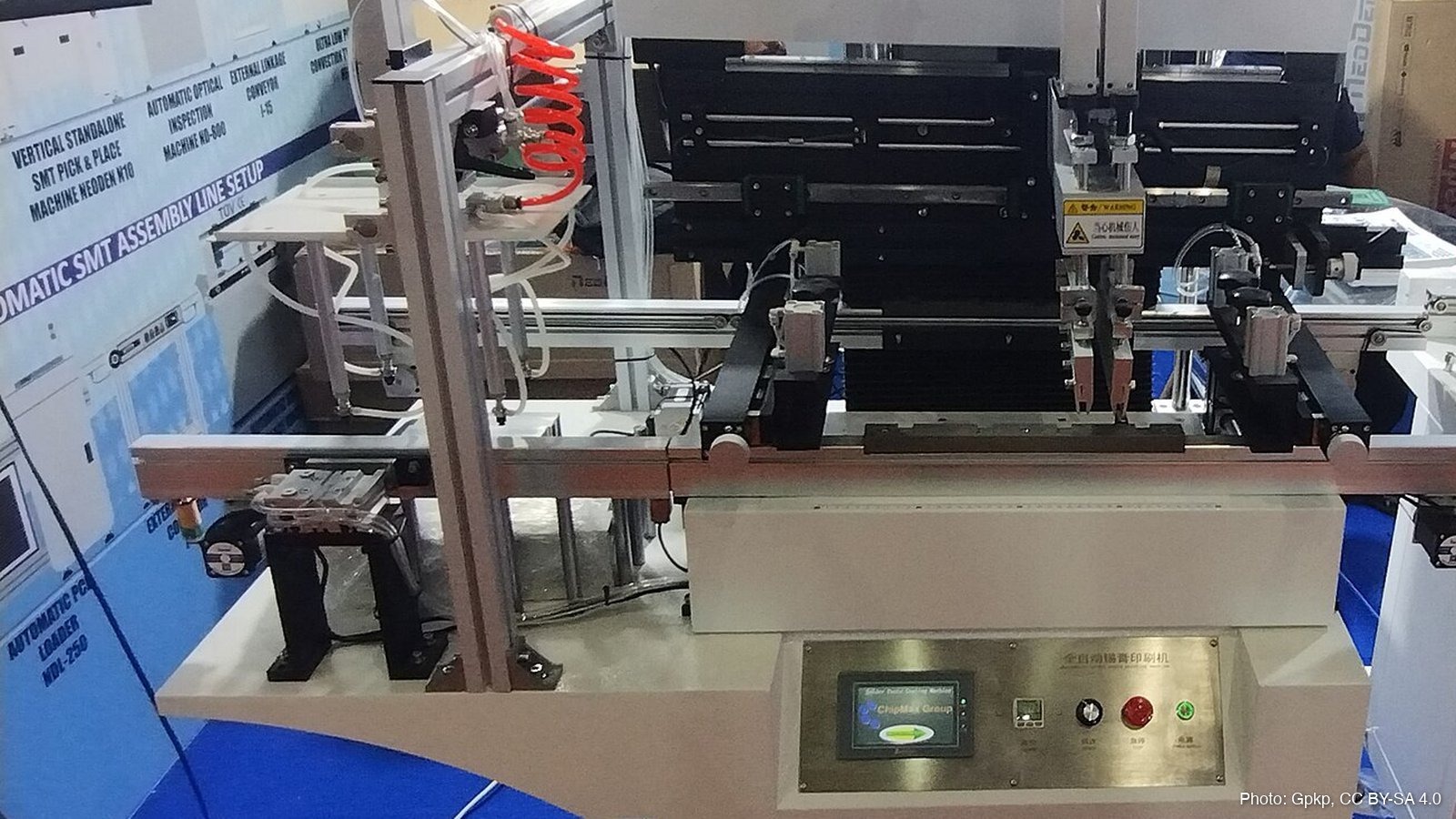
- Cover photo: An SMT production line for circuit boards on show at Electronica, Bangalore International Exhibition Centre (2025), by Gpkp, CC BY-SA 4.0

You may republish this story under CC BY 4.0: credit Pranav Sharma and link to this page.