Delhi airport flew 38.5 million people in six months. Here is how it earns from them
Version 1 of 1 saved 21 Oct 2026, 3:43 am IST · Chain line 103
As it was first published
Delhi airport flew 38.5 million people in six months. Here is how it earns from them
India's busiest airport had its biggest April to September ever. A simple look at who runs it and how fees, shops and duty free bring in money.
Picture this. Every single month from April to September 2026, about 6.5 million people walked through Delhi airport. That works out to more than 2 lakh people a day, every day. Data shared on 20 October 2026 showed that Delhi's Indira Gandhi International Airport handled 38.5 million passengers in the first half of FY27, its highest ever for that stretch of the year.
So who runs this giant place, and how does it actually make money? Let us break it down, one boarding gate at a time.
First, the big numbers
A "financial year" in India runs from April to March. FY27 means April 2026 to March 2027. The "first half", or H1, is simply April to September.
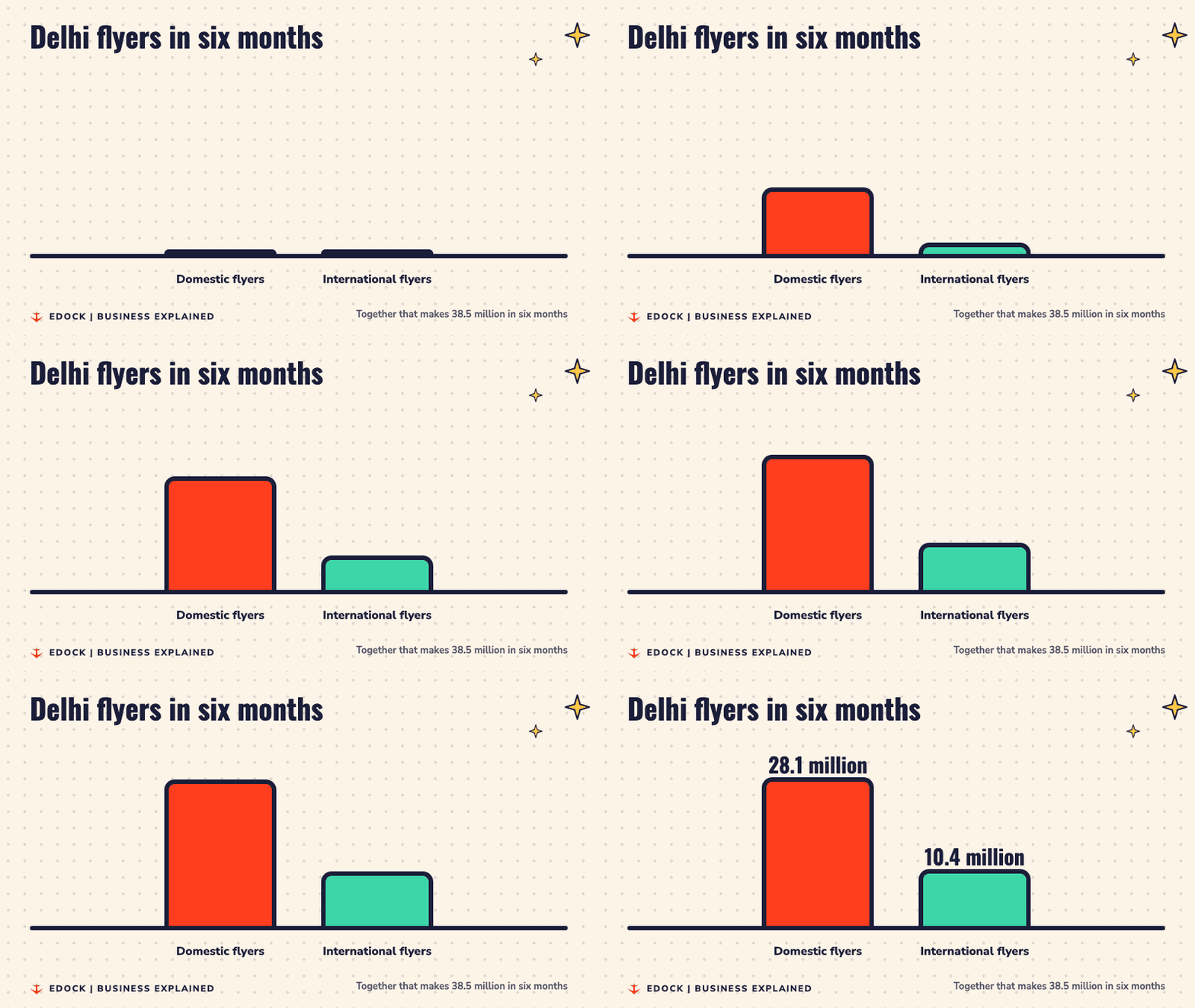
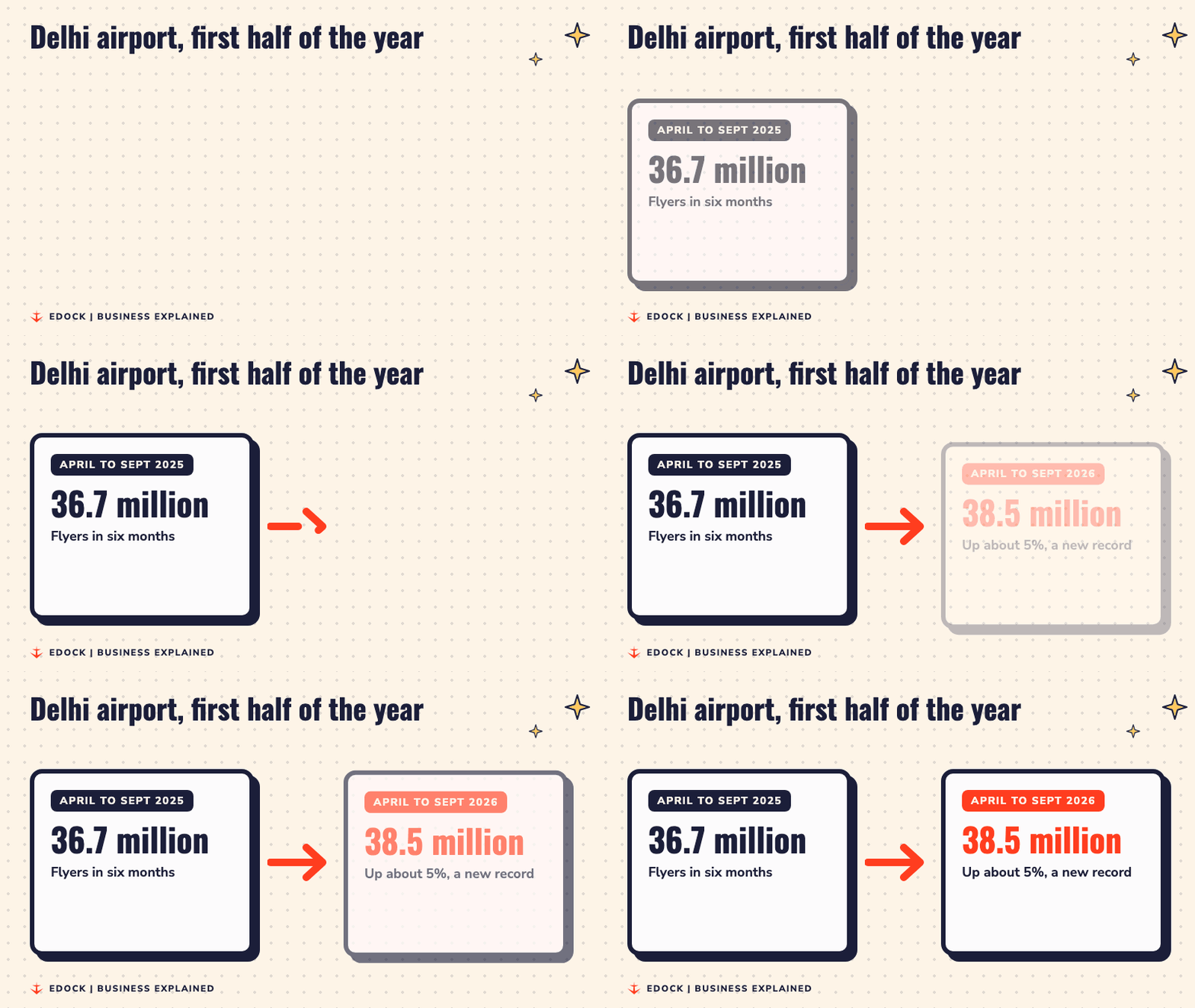
In that first half, Delhi airport saw about a 5% rise in passengers, up from 36.7 million in the same six months a year earlier. Out of the 38.5 million, 28.1 million flew within India and 10.4 million flew to or from other countries.
Planes got busier too. Air Traffic Movements, which means every take off and every landing counted one by one, rose 6.9% to 2,33,331 in those six months, as per data from GMR Airports.
Why was last year lower? The same report says the year-ago period saw a dip because of temporary flight disruptions, airspace restrictions and repair work on one of the runways, called runway 10/28. So part of this year's jump is the airport bouncing back to normal.
Who runs Delhi airport?
The airport is run by a company called Delhi International Airport Ltd, or DIAL, which is part of GMR Airports. Think of DIAL like the team that runs a school canteen. It keeps the counter open, serves the crowd and keeps the money flowing.
GMR Airports does not run just Delhi. It also runs airports in Hyderabad, Mopa in Goa, Nagpur, Bhogapuram and Medan in Indonesia. Across all of them, it handled 58.2 million passengers in April to September, up 0.5%. That means Delhi alone brought in about two out of every three of its flyers.
How does an airport earn money?
An airport earns in two big ways. Airport people call them "aero" and "non-aero" money.
1. Aero money: charges linked to flying
"Aeronautical" just means anything to do with planes flying. Airlines pay the airport charges such as landing charges, a bit like paying a parking fee every time a car enters a mall.
Flyers pay too, often without noticing. It is called the User Development Fee, or UDF, and it is added to the air ticket. At Delhi, the regulator kept the UDF at Rs 129 for domestic passengers for the period from April 2024 to March 2029, because they make up 80% of all traffic. International economy flyers pay Rs 650 when leaving and Rs 275 when arriving.
Who decides these fees? A government body called the Airports Economic Regulatory Authority, or AERA. An airport cannot raise prices like a samosa stall can. It has to ask AERA first. For Delhi, the airport had asked for a huge rise. AERA allowed a 148% increase in aeronautical charges, far less than the 730% DIAL had proposed. The money the airport earns from each passenger on these charges went from Rs 145 to Rs 360, GMR Airports said in a filing.
2. Non-aero money: everything else
This is the money from shops, cafes, duty free stores and other businesses inside the airport. Every chai, sandwich or perfume bottle you buy at the airport helps here.
It is big money. In the nine months to December 2024, Delhi airport's non-aero revenue rose 12% to INR 24.2 billion, or Rs 2,420 crore. Retail earned Rs 680 crore of that, and food and drinks earned Rs 240 crore. An average duty free shopper spent Rs 1,026 per passenger in that period.
Here is a fun detail from the same report. In one quarter, non-aero revenue grew 13.1% while passengers grew only 8.1%. In plain words, each flyer was spending a little more than before.
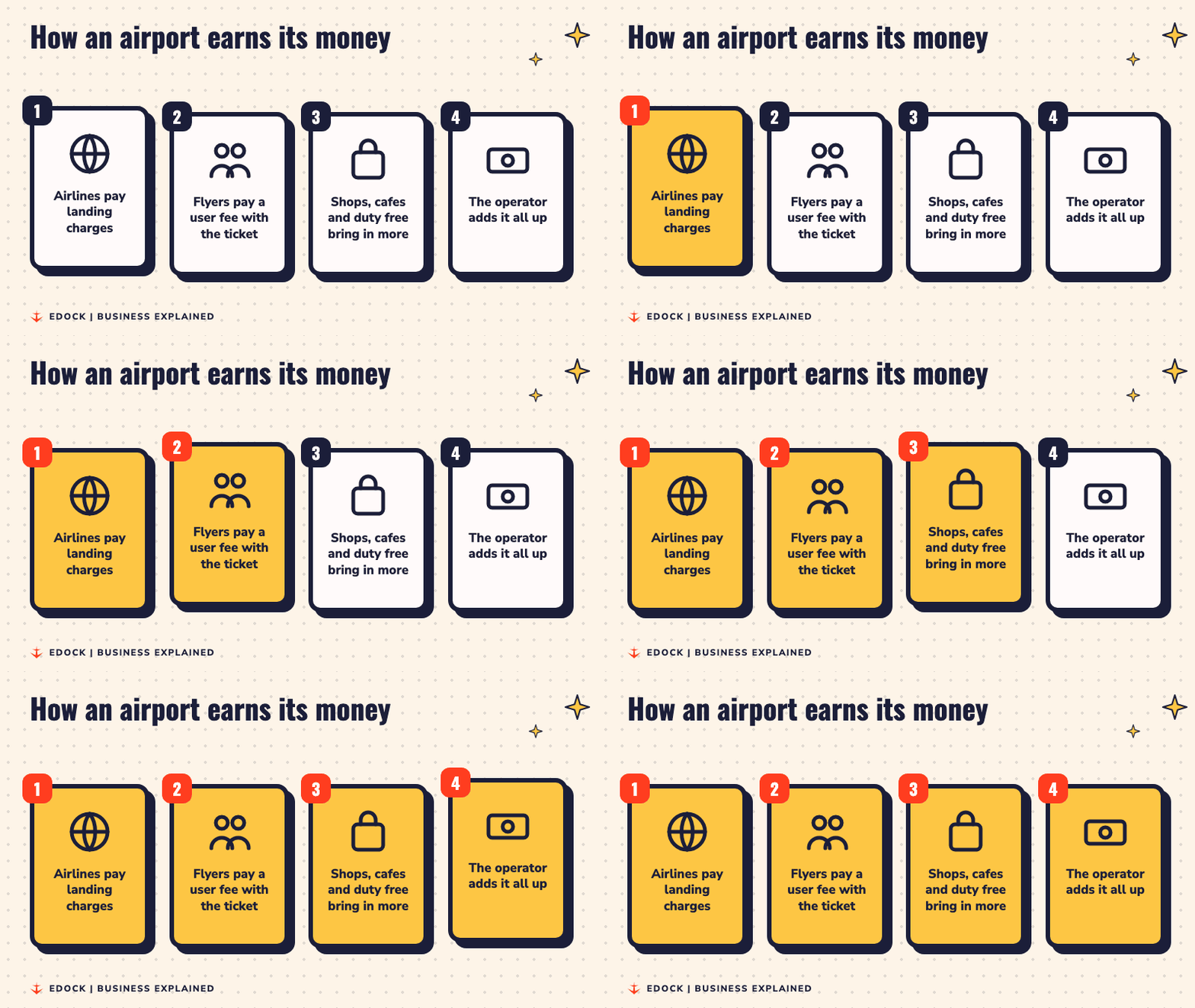
For the full company, GMR Airports reported its highest ever revenue of Rs 15,200 crore in FY26 and a return to profit. That report says more travellers lifted aero income, while retail, duty free, cargo and concession income lifted non-aero earnings. "Cargo" means goods sent by air, like phones or medicines in a plane's belly.
Why more flyers means more money
Here is the simple maths of an airport. More flyers mean more user fees. More flights mean more landing charges. And more people waiting at gates mean more coffee, more snacks and more shopping.
That is why a 5% rise in passengers matters so much for a company like GMR. It is like a lemonade stall at a busy bus stop. When more buses arrive, the stall does not need to change anything to sell more.
Is Delhi airport getting full?
Delhi airport has three terminals, T1, T2 and T3, and four runways. Together, the terminals can handle 106 million passengers a year. T1 takes 42 million, T2 takes 14 million and T3 takes 50 million.
In the full 2025-26 year, the airport handled 78.7 million passengers. So there is still room, but the plan is to grow. Under its latest ten-year master plan, the airport wants to handle 125 million passengers a year, with 86 million domestic and 39 million international.
It is not just Delhi
Other cities are getting busier too. In Lucknow, the airport plans to raise daily flight movements from 108 to 134 under the winter schedule, which starts on 25 October. Direct flights to Bangkok are set to return on 17 November. Airport sources said these plans depend on the schedules airlines submit, so they could still change.
For young Indians, this means more routes, more choice and more reasons to fly for college, work or a trip with friends. For airport companies, it means every extra flyer is an extra customer.
The quick recap
- Delhi airport handled 38.5 million passengers from April to September 2026, about 5% more than a year earlier and a new record for that half.
- 28.1 million were domestic flyers and 10.4 million were international.
- The airport is run by DIAL, part of GMR Airports.
- Airports earn from flying charges, like landing charges and user fees, and from shops, food and duty free.
- Delhi can handle 106 million flyers a year now and plans to reach 125 million.
Sources
- ET Government: Delhi airport passenger traffic rises 5% to 38.5 million in H1 FY27
- Mint: Delhi airport traffic hits record first-half high with 38.5 million passengers
- The Week (PTI): AERA decides to hike UDF for international passengers at Delhi airport
- IANS: International passengers to shell out more at Delhi airport from April 16
- The Moodie Davitt Report: GMR Airports posts strong Q3 commercial revenues growth in Delhi and Hyderabad
- India Sea Trade News: GMR Airports achieves highest ever revenue in FY26
- BusinessLine: Lucknow airport expands operations to 134 flights, restarts Bangkok service
- Cover photos: Terminal 3 Interior, Indira Gandhi International Airport, Runway 11-29 and Taxiway adjacent to Runway 11-29, by Biswarup Ganguly, CC BY 3.0


