Costly memory chips open the door for Indian phone brands like Lava and Ai+
Version 1 of 1 saved 17 Oct 2026, 9:48 pm IST · Chain line 76
As it was first published
Costly memory chips open the door for Indian phone brands like Lava and Ai+
Big brands are pulling back from cheap phones as memory costs jump. Ai+, Lava, Mivi and Boltt are stepping in, and Micromax may come back.
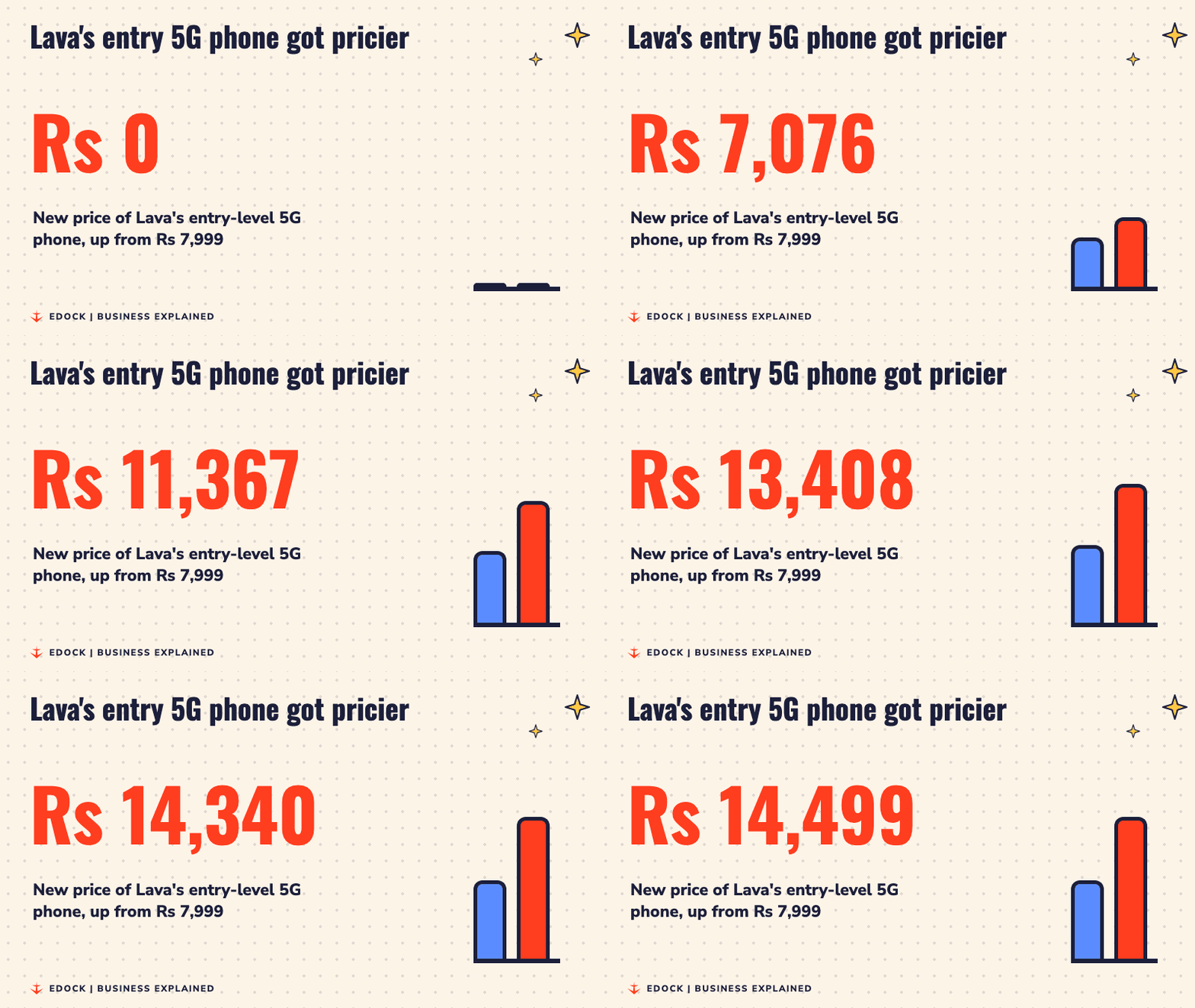
Picture this. Lava's entry-level 5G phone used to cost Rs 7,999. Now it costs Rs 14,499. That is Rs 6,500 more for the same kind of starter phone.
The reason is a tiny part inside every phone: the memory chip. Its price has shot up, and big global brands are stepping back from cheap phones. On October 16, 2026, ET Retail reported that Indian phone brands are rushing into the space they are leaving behind.
What is happening, in one line?
Phones under Rs 20,000 have become hard to make cheaply. Samsung, Oppo, Vivo and Xiaomi have reduced their presence in the entry-level market, industry executives told ET Retail. Homegrown brands see an empty seat at the table and want to sit in it.
Who are the new players?
Some of the names may surprise you, because they are better known for earphones and smartwatches.
- Mivi and Boltt have already entered the phone market under Rs 15,000 through Flipkart. Mivi's phone, the Mivi One 5G, went on sale on Flipkart from October 8, 2026.
- Noise and boAt are exploring an entry and holding talks with online marketplaces, three senior executives said. GoBoult's co-founder said the company has no plans to make phones.
- Ai+ and Lava are already seeing early success. Ai+ says it has sold as many phones this quarter as in all of last year, with prices from Rs 10,000 to Rs 25,000. Lava says its sales have more than doubled this financial year.
- Karbonn and Micromax, two older Indian brands, want back in. Karbonn is planning a festive-season relaunch, and Micromax is looking at a return to smartphones.
Why did memory chips get so expensive?
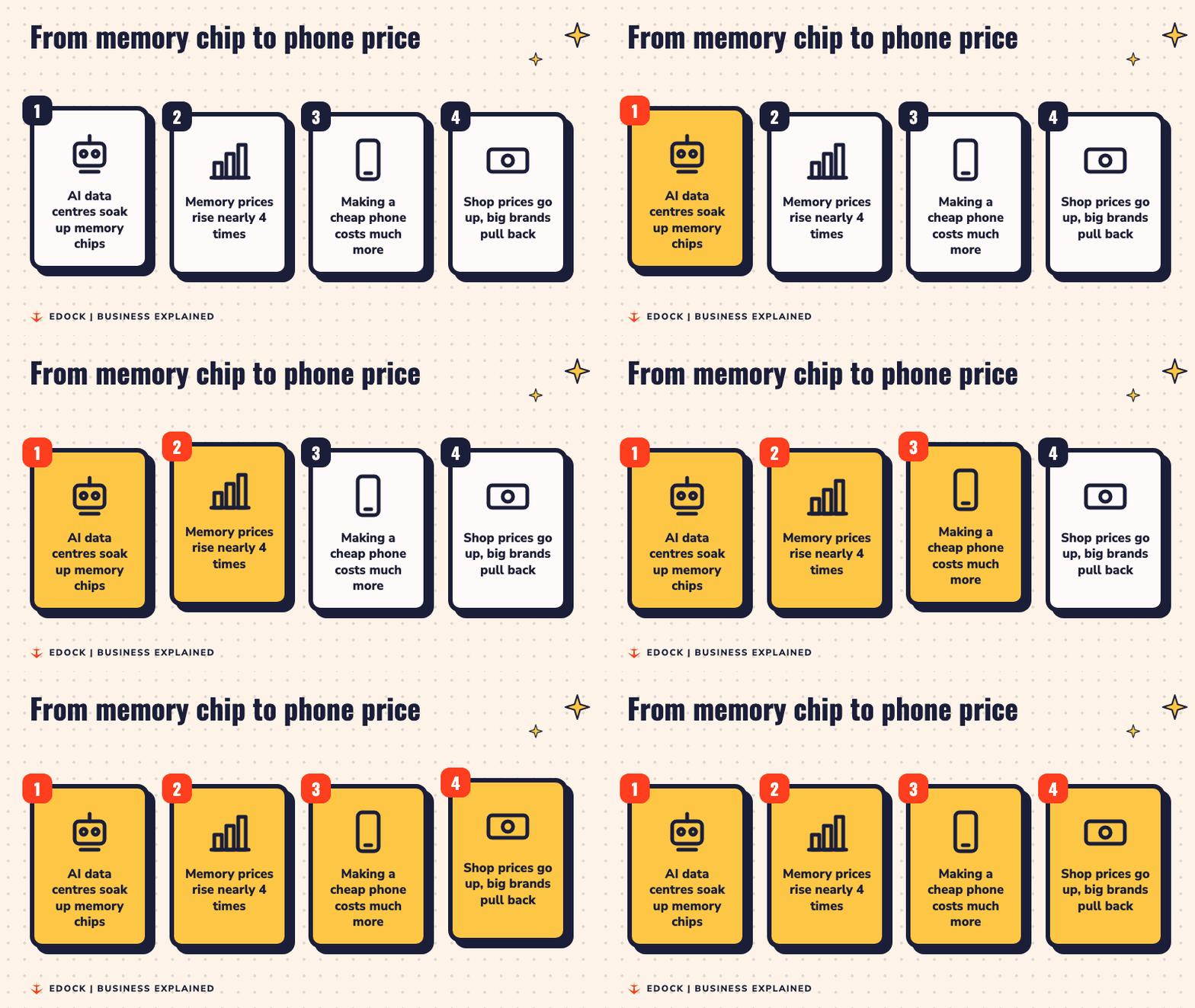
Memory chips are where a phone keeps your apps, photos and everything it is working on right now. The same kind of chips also run giant AI computers. AI data centres have been soaking up memory supply, so less is left for phones, and the price goes up.
How much? Research firm Counterpoint says memory prices have risen nearly four times since September 2025. Think of it like the price of onions jumping four times. Every dish that needs onions suddenly costs more.
A weaker rupee has also made imported parts dearer, Digit reported. Counterpoint does not expect memory prices to come down before 2028.
Why does this hurt cheap phones the most?
Every product has a "bill of materials". That is simply the list of parts and what each one costs. For a samosa stall, it is potatoes, flour, oil and spices. For a phone, it is the screen, battery, camera, chip and memory.
In budget phones, memory can make up around 40% of the bill of materials. So when memory prices jump, the whole phone gets much costlier. An expensive phone has more room to hide a price rise. A cheap phone does not.
The numbers show it clearly. Counterpoint says phones under Rs 10,000 got about 32% costlier on average in the first half of 2026, and sales of such phones fell 65% compared with a year earlier. Across all phones, prices rose 16% on average.
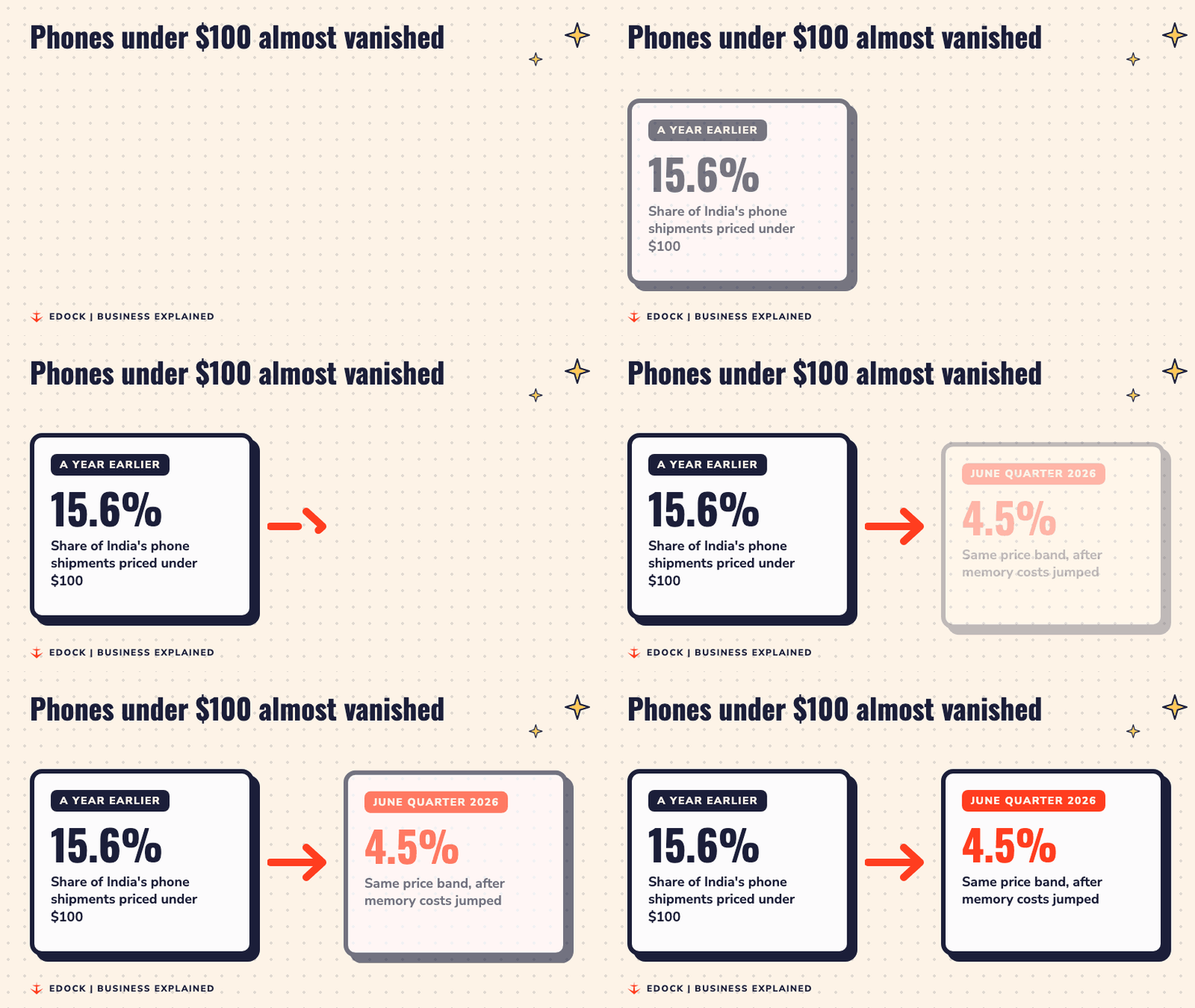
Another research firm, IDC, found that phones under 100 dollars made up just 4.5% of shipments in the June quarter, down from 15.6% a year earlier. "Shipments" means phones sent from companies to shops, a good sign of how many people are buying.
How can Indian brands sell cheaper?
They have a few tricks.
No foreign head office to pay. Madhav Sheth, founder of Ai+, told ET Retail that as an Indian brand there are no royalty and profit pressures from overseas headquarters. A royalty is a fee paid to use a brand name or technology, like a shop paying a franchise fee for a famous name.
Selling online first. Instead of placing phones in thousands of shops, the new brands sell mainly through apps like Flipkart. That keeps delivery and running costs low, like a home baker selling on Instagram instead of renting a shop.
Smart parts shopping. Lava says it stays competitive by choosing parts carefully, improving software and sourcing strategically, which means buying parts from the right suppliers at the right time.
A push from the government. Under the Mobile Phone Manufacturing Scheme, or MPMS, Indian brands get an incentive of 5%, plus another 3% for Indian design and research. An incentive is a reward for doing something the government wants, like a bonus for making phones in India. Together that is up to 8%. Micromax founder Rajesh Agarwal said the scheme would provide some benefits.
Is the market growing or shrinking?
Shrinking, for now. IDC expects India's phone shipments to fall by more than 15% in the second half of 2026. For the full year, it sees about 128 to 130 million phones, down from 152 million in 2025. That is 22 to 24 million fewer phones.
So the new Indian brands are jumping into a smaller pond. But it is a pond where the big fish are swimming away from the shallow end. Sheth said the entry segment is where 80% of consumers are.
What does this mean for buyers?
- More choice under Rs 15,000. Names like Mivi, Boltt, Ai+ and Lava are filling gaps the big brands left.
- Prices will likely stay high. With memory costs expected to stay up till 2028, a big price drop looks unlikely soon.
- Do some homework. Before buying any phone, from a new brand or an old one, read reviews and check where the nearest service centre is.
- 4G phones are back. To keep prices low, brands are bringing back 4G models. Their share rose to 11.1% of shipments, IDC said.
In short, a chip shortage caused by AI computers far away has opened a door for Indian brands at home. Whether they can stay in the room depends on quality, service and how long memory stays costly.
Sources
- Homegrown firms enter budget smartphone market as memory chip prices rise, ET Retail, October 16, 2026
- India's smartphone shipments set to fall over 15% in H2 2026, Free Press Journal
- Smartphone prices rise across India as memory costs climb, Digit, September 29, 2026
- Mivi One 5G launched in India, TelecomTalk
- How global chip shortage is impacting India's smartphone market, Firstpost on YouTube
- Cover photo: Colored pen and smartphone on a table, by Gabriel Santiago, CC0; and MT4C1024-HD, by ZeptoBars, CC BY 3.0

