Clean-tech startups raised a record $433 million in three months
Version 1 of 1 saved 12 Oct 2026, 9:40 am IST · Chain line 21
As it was first published
Clean-tech startups raised a record $433 million in three months
Electric scooter and bike makers took most of the money. Here is who got it and what they plan to build, in super easy words.
Picture your cricket team scoring almost four times more runs this season than last season. That is roughly what just happened to clean-tech startups in India.
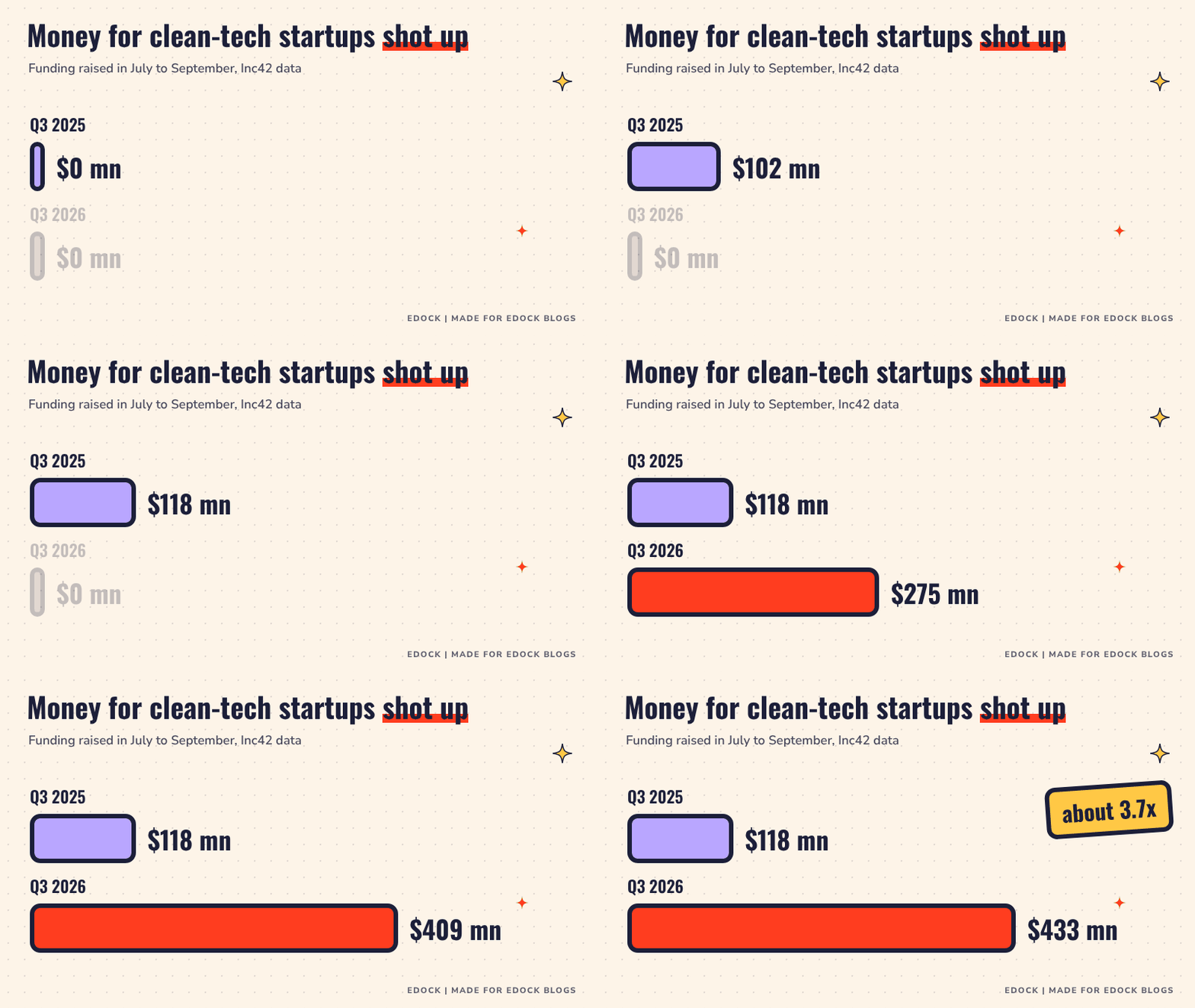
On October 10, 2026, the startup news site Inc42 reported that Indian clean-tech startups raised a record $433 million from July to September 2026. In the same three months of 2025, they raised only $118 million.
And most of that money went to companies that make electric scooters and bikes. Let us break it down, step by step.
First, some simple words
Clean-tech means businesses that make things with less pollution. Think electric scooters, batteries and cleaner fuels.
A startup is a young company trying to grow fast. To grow, it needs money. So it asks investors for help. Investors give money and get a small piece of the company in return.
Think of a lemonade stall. A friend gives you ₹100 to buy more lemons. In return, you promise them a small share of the stall. That is funding. Each time a company collects money like this, it is called a deal or a round.
A quarter is three months. July, August and September make up the third quarter, or Q3. Inc42 counted money announced up to September 24.
How big is the jump?
Here are the numbers from Inc42's report:
- Q3 2025: $118 million across 16 deals.
- Q3 2026: $433 million across 23 deals.
- The average deal grew from about $7 million to about $19 million.
- Electric vehicles (EVs) made up 57% of these clean-tech deals.
So the money grew about 3.7 times. The number of deals grew by about 44%. And each deal got much bigger. It is like your pocket money going from ₹70 a week to ₹190 a week.
Three companies took most of the money
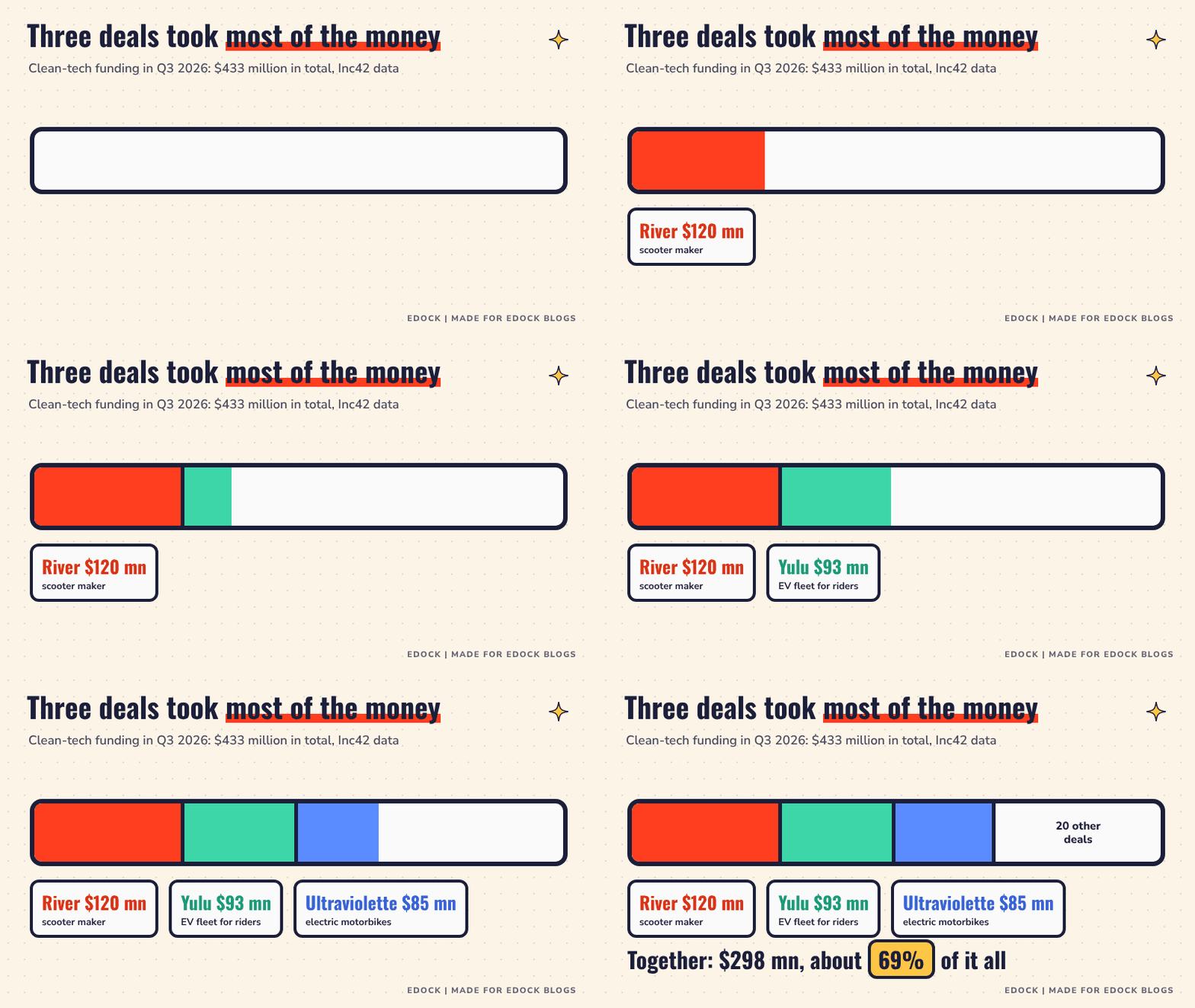
Inc42 says just three EV companies raised $298 million together. That is nearly 69% of the whole $433 million.
- River, which makes an electric scooter: $120 million.
- Yulu, which runs a big fleet of electric scooters: $93 million.
- Ultraviolette, which makes electric motorbikes: $85 million.
River: one scooter, big plans
River was started in 2021 by Aravind Mani and Vipin George. According to TechCrunch, it has sold just one model so far, a scooter called the Indie, launched in 2023. It costs ₹1,55,000.
River announced its $120 million round on August 5, 2026. The round was led by Elev8 Venture Partners and Claypond Capital. Older backers like Yamaha Motor and Mitsui also put in money again.
River has sold more than 50,000 scooters through more than 75 stores. It wants more than 200 stores by March 2027. It is also building a new factory. The first part should be ready by mid-2027 and make 7 to 8 lakh vehicles a year. (One lakh is 1,00,000.)
In September 2026 alone, 5,549 River scooters were registered, says Inc42, using government Vahan data.
Yulu: scooters for delivery riders
Yulu is from Bengaluru. It runs a fleet of electric scooters used by riders, many of them delivery workers.
On August 12, 2026, Mercom reported Yulu's $93 million round, led by GEF Capital Partners. But not all of it is the same kind of money:
- $63 million is equity. Investors get a piece of the company, like the lemonade friend.
- $30 million is debt. That is a loan. Yulu must pay it back, like borrowing ₹50 from a friend for the canteen.
Yulu wants to grow its fleet four times, to 2,00,000 EVs in two years. It works in 12 big city markets, including Bengaluru, Mumbai, Delhi NCR and Hyderabad. The company says its scooters help with more than 7,50,000 doorstep deliveries every day. It also says its revenue grew seven times from FY2023 to FY2026.
Ultraviolette: electric motorbikes going abroad
Ultraviolette makes electric motorbikes, like the F77 and the X-47. On September 23, 2026, Business Today reported its $85 million round, led by Yali Capital and TDK Ventures. Lip-Bu Tan, chairman of Walden International, also put in money.
The company plans to use the money to make more bikes, including two upcoming models called Tesseract and Shockwave. It also wants to start selling in the United States in 2027. A new factory will help it make up to 5,00,000 units a year.
Are people actually buying EVs?
Yes, more and more. In September 2026, 2.07 lakh electric two-wheelers were registered in India, up 12.2% from 1.84 lakh in August. TVS Motor had the most, with 53,989.
Inc42 also shared an estimate from JMK Research: 15.41 lakh EVs of all kinds were registered in the first half of 2026, up 43% from a year before.
Another scorecard says the same thing
A second news site, Entrackr, keeps its own count. It says EV startups raised $583 million in Q3 2026. Only AI startups raised more, at $635.3 million. Entrackr also counted a $182 million round for Simple Energy, another electric two-wheeler maker.
Why are the two numbers different? Each site counts in its own way, with different dates and groups. It is like two friends keeping score in gully cricket with different rules for wides. Both still agree on one thing: EVs had a big quarter.
Why are investors excited?
Navin Honagudi of Elev8 Venture Partners, which led River's round, told Inc42: "What's different this cycle is that capital is backing businesses and not just the energy transition."
In simple words: investors are not giving money just because EVs are good for the planet. They want companies that can sell a lot and make money.
What could go wrong?
Shubham Jhuria of Aeravti Ventures gave a warning in the same report. Investors may get less excited if these companies keep needing huge amounts of money without better unit economics.
Unit economics means how much you earn on each thing you sell, after paying its costs. Say a samosa costs ₹12 to make and sells for ₹15. You earn ₹3 on each one. If every samosa loses money, selling more only makes things worse.
River, for example, told TechCrunch it expects to make an operating profit only when it sells 20,000 to 25,000 vehicles a month. It is aiming for that around 2028 to 2029.
The short version
- Indian clean-tech startups raised a record $433 million from July to September 2026.
- River, Yulu and Ultraviolette took nearly 69% of it.
- More Indians are buying electric two-wheelers every month.
- Now these companies must prove they can make money on every scooter they sell.
Sources
- Inc42: EV bets drive India's cleantech funding surge in Q3
- Inc42: E2W registrations rebound 12% MoM in September
- TechCrunch: Indian EV two-wheeler startup River raises $120M
- Mercom: Yulu raises $93 million in Series C funding
- Business Today: Ultraviolette raises $85 million
- Entrackr: Indian startups raise $2.9 Bn in Q3 2026
- Cover photos: NIU N1 smart electric scooter on a parking lot in Vienna, by Ivan Radic, CC BY 2.0; Gogoro Smart Electric Scooter, by Maurizio Pesce, CC BY 2.0

