Celebrity ads on TV fall 17% as sports stars win more screen time
TAM AdEx data for January to September 2026 shows fewer star-led TV ads, with athletes now fronting 28% of them, up from 19% a year ago.

Picture yourself watching a cricket match on TV. The over ends, and the ad break starts. A film hero sells you a phone. A cricketer sells you a shoe. Now count how often a famous face shows up. In 2026, that count went down, and the faces changed.
On 21 October 2026, The Economic Times reported new TAM AdEx data showing that celebrity ads on TV fell 17% in January to September 2026, compared with the same months last year. At the same time, sports stars grabbed a much bigger slice of the celebrity ads that did run.
First, what is an endorsement?
An endorsement is when a famous person puts their face and name on a product in an ad. Think of a cricket captain telling you which chai to drink. The brand pays the star, and hopes the star's shine will also make the product look good. A star who signs up with a brand for a long time is called a brand ambassador.
Why do brands do this? TAM Media Research, a company that tracks what plays on Indian TV, says in its report on celebrity ads in 2025 that stars can help people remember a brand, build its image and connect with buyers emotionally.
How do you measure "ad volume"?
TAM AdEx does not count rupees here. It counts time. Its 2025 report says the figures are based on how long the ads run on TV, using only commercial ads, without channel promos or social messages.
So "ad volume" is like a stopwatch. Every time an ad plays on any channel, its seconds are added to the total. Add up every channel, and you get hours of ads per day. A 17% fall means the stopwatch for celebrity ads stopped earlier this year.
The fall did not start in 2026. TAM's 2025 report gives each year a score, with 2023 set at 100. Celebrity ads scored 103 in 2024 and 80 in 2025. In 2025, only 27% of TV ad time had a celebrity in it. The other 73% had none.
The big shift: from film sets to cricket grounds
Here is the most interesting part. Film actors and actresses still own most celebrity ads. But their share is shrinking. In January to September 2026, film stars made up 65% of celebrity ad time, down from 72% in the same months of 2025. Sports stars jumped from 19% to 28%.
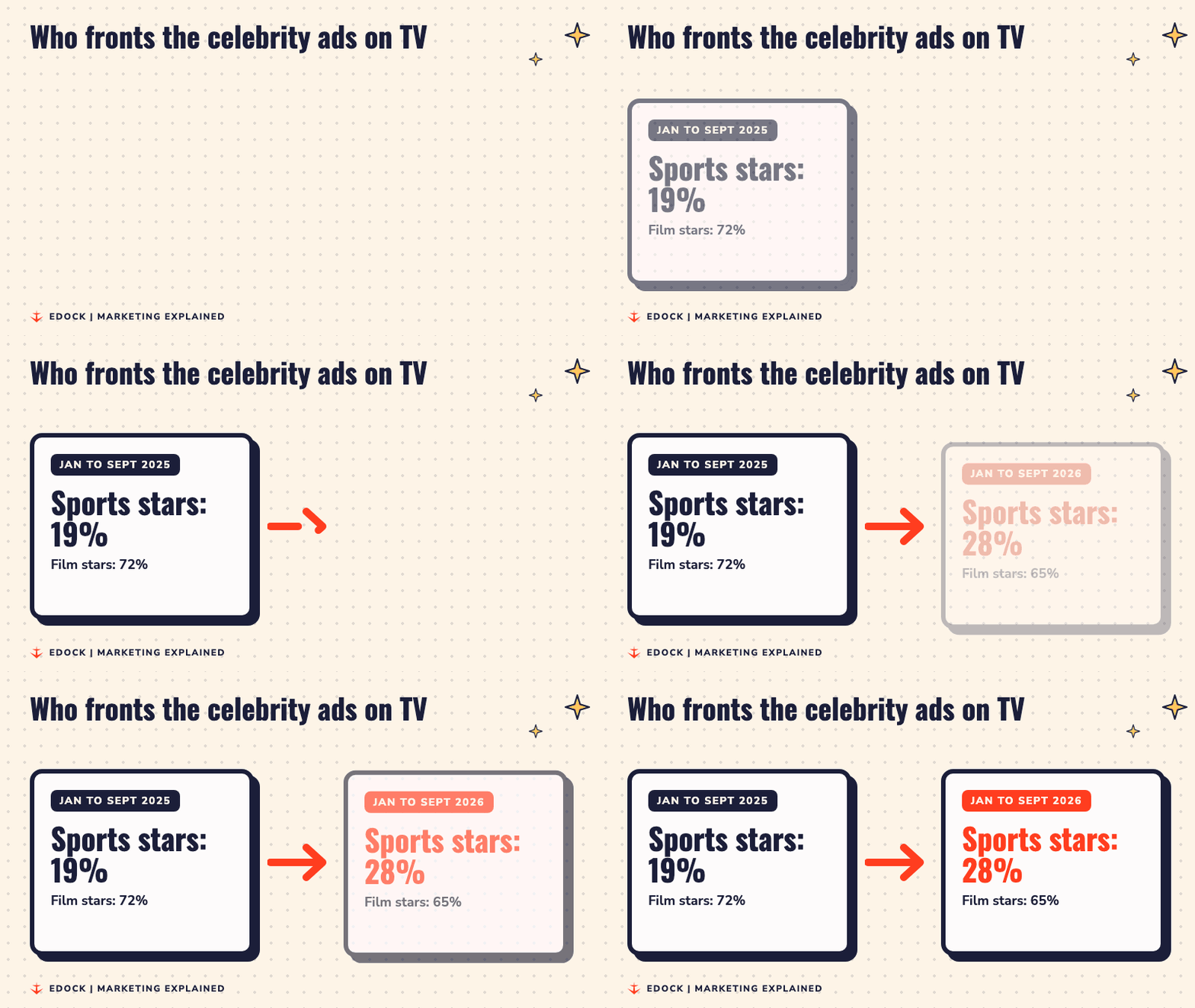
Think of it like a school prize day. Last year, film stars took home most of the trophies. This year they still win the most, but the athletes are now walking up to the stage far more often.
Who showed up the most?
Shah Rukh Khan was the most visible face. He made up 10% of celebrity ad time. M S Dhoni came next at 8%, and fast bowler Jasprit Bumrah at 3%.
Put another way: across all TV channels, Shah Rukh Khan's ads ran for 26 hours every day on average. Dhoni's ran for 22 hours a day. That is more than a full day of ads, every single day, because many channels play them at the same time.
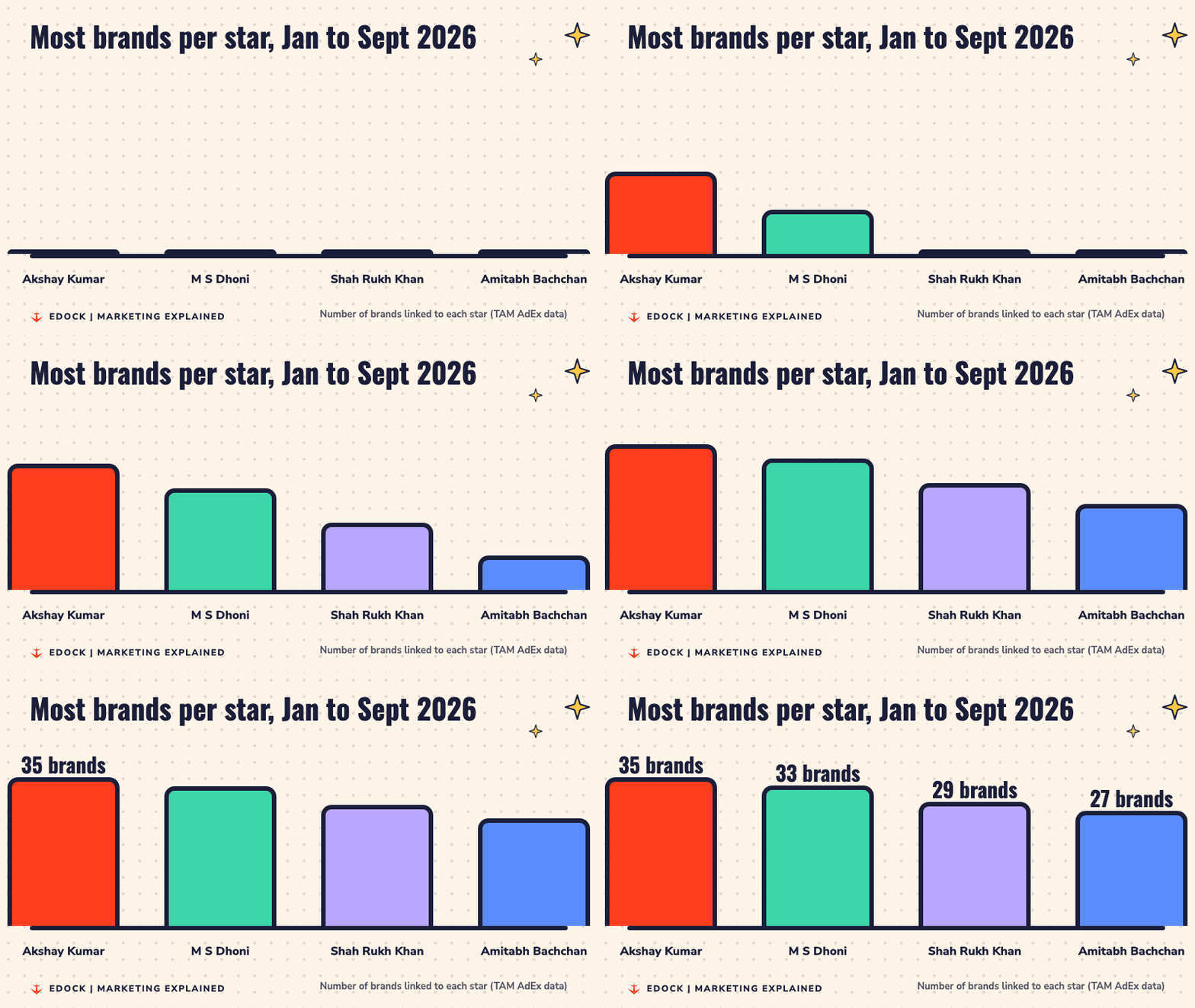
Counting brands gives a different winner. Akshay Kumar was linked to 35 brands. Dhoni had 33, Shah Rukh Khan 29 and Amitabh Bachchan 27. Sachin Tendulkar and Sourav Ganguly had 24 each. So three of the top six names on the brand list come from cricket.
Couples count too. Ranbir Kapoor and Alia Bhatt topped the couples list with a 19% share and 37 brands. The top four couples, including Ajay Devgn and Kajol, together made up half of all ads by celebrity couples.
Why are brands picking athletes?
The reason, as TAM Media CEO LV Krishnan explained to ET, is that sports now happen all year, so star athletes get a lot of attention on both social media and traditional media. He said companies are signing athletes as brand ambassadors to win the attention of Gen Z, which simply means today's teenagers and young adults.
He also linked it to brand equity. That is the trust and good feeling a name builds over time. Think of the samosa stall near your college that everyone recommends. People keep going back even when a new stall opens next door. Brands hope athletes can help build that kind of long-term loyalty.
The IPL shows how strong this pull is. A separate TAM report on IPL 2026, reported by afaqs, found that celebrity ads made up 61% of all ad time during live IPL matches, up from 53% in 2025. The number of sports personalities in those ads grew by 52%. Rohit Sharma led the sports names with a 22.1% share of sports celebrity ad time, followed by Hardik Pandya at 16%.
The cricket season effect
Celebrity ads did not run evenly through the year. They peaked in April to June 2026, at an average of 308 hours a day. January to March had 252 hours a day, and July to September had 234. TAM AdEx linked the peak to the IPL season. May had the biggest monthly share at 15%, and July the smallest at 8%.
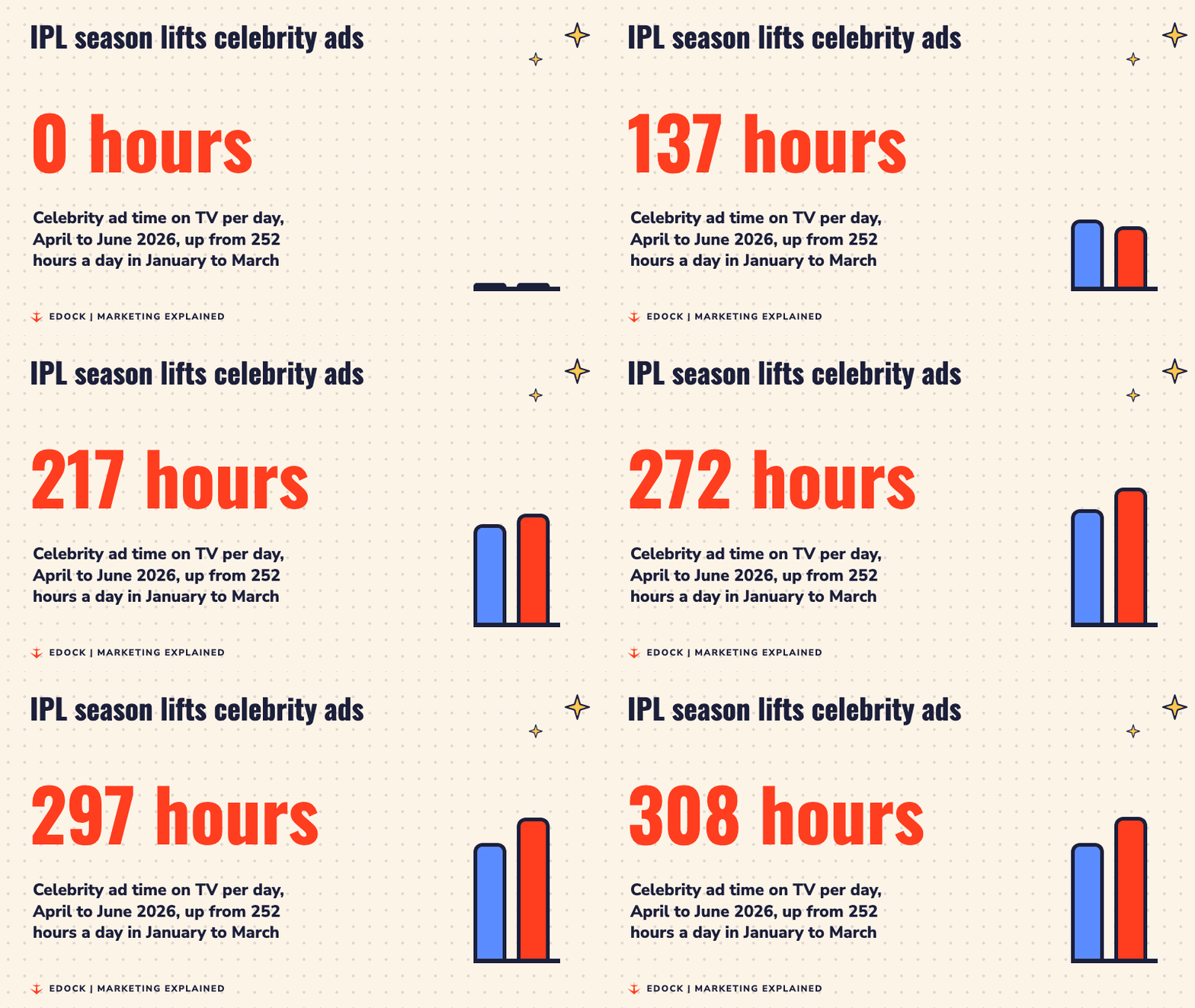
Compare that with last year. TAM's 2025 report shows 315 hours a day in January to March 2025, 347 in April to June and 294 in July to September. So every quarter of 2026 was lower: 63 hours a day less in the first quarter, 39 less in the IPL quarter and 60 less in the third.
Which products use the most stars?
Food and drinks led the way with 25% of celebrity ad time. Personal care and hygiene products came next at 18%, and household products at 9%. As single product types, toilet and floor cleaners had 8%, and toilet soaps 7%.
Paint brands signed the most different stars, 36 of them. Building materials came next with 31.
This pattern is not new. In the first half of 2025, BestMediaInfo reported that toilet and floor cleaners were also the top category at 8% of celebrity ad volumes, with food and beverages the top sector.
What this means for you
If you plan to work in marketing, this is a useful lesson. A famous face is not a magic button. Brands now mix star ads with ads that have no star at all, and when they do pick a star, more of them pick an athlete. For a young viewer, the takeaway is simple: the next time a player sells you a drink between overs, a brand made that choice on purpose, using data like this.
Sources
- The Economic Times: Celebrity-endorsed TV ad volumes fall 17% as sports stars gain ground
- TAM AdEx: Celebrity led TV advertising, key trends from 2025
- afaqs: Shah Rukh Khan tops IPL 2026 celebrity endorsement charts
- BestMediaInfo: SRK most visible celebrity on TV in January to June 2025
- Video: Moneycontrol: Why celebrity endorsements are under the radar
- Cover photo: Cricket turf under floodlights, by Hiral Solanki, CC0
You may republish this story under CC BY 4.0: credit Pranav Sharma and link to this page.