Canva launches Craft, its first AI model that draws pictures from words
Version 1 of 1 saved 23 Oct 2026, 8:44 am IST · Chain line 162
As it was first published
Canva launches Craft, its first AI model that draws pictures from words
The design app built its own image model to get text right in posters and to cut the rising cost of renting AI from other firms.
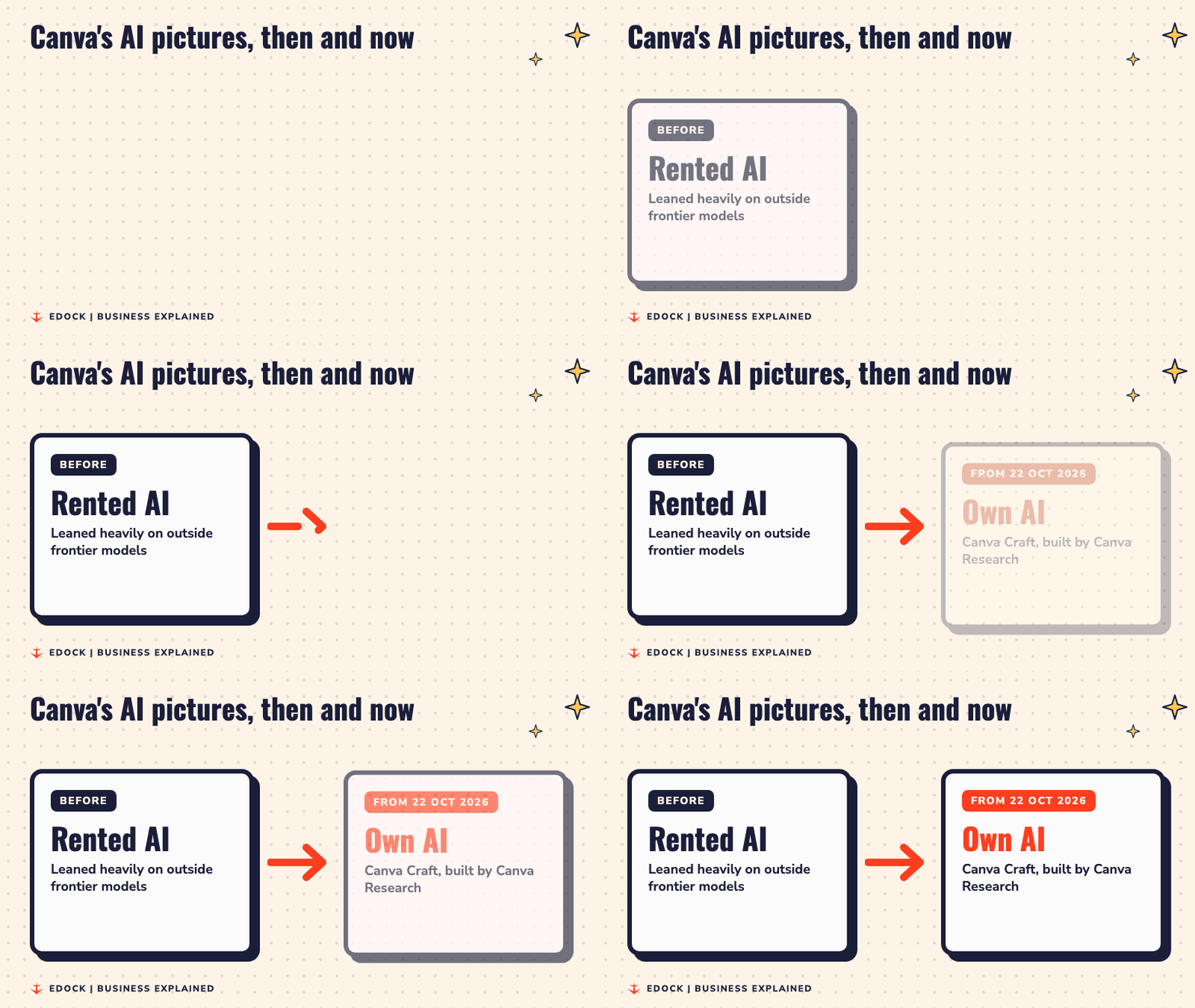
Picture this. You type "a chai stall poster with a purple sky and the words Monsoon Offer" and, a few seconds later, a finished poster appears, with every letter spelled right. On 22 October 2026, Canva launched Canva Craft, the first picture making AI it has built on its own. Until now, the design app had leaned a lot on AI models made by other companies.
If you have ever made a school project cover, a birthday invite or an Instagram post on your phone, there is a good chance you have used Canva. So this launch is about a tool many young people already open every week.
First, what is Canva?
Canva is an online design app. It gives you ready made templates (a template is like a filled in sample page you can change, the way you copy a friend's notes layout and add your own words). You drag in photos, change colours and download the result.
It is a big company. Canva told TechCrunch it had more than 265 million monthly active users and over 31 million paid users in 2025. A monthly active user is someone who opens the app at least once in a month. In the Craft announcement, Canva says people create over 400 designs every second on it.
What is an image generation model?
An image generation model is software that draws a picture from words. You write a prompt (the instruction you type, like a food order at a counter) and the model makes an image to match it.
Big tech firms already have such models. TechCrunch says Craft is meant to compete with models from Google, OpenAI, ByteDance and Meta. Many of these tools are great at pretty photos but often mess up the words inside a picture. A poster that says "Monsoon Ofer" is no use to a shop owner.
How Craft works, in two steps
Canva says Craft does not jump straight to drawing. It works in two stages.
- Stage one: plan. A planning model reads your prompt and writes a plan. Which things appear, where they sit, how big each one is, what is most important, and what text must show up.
- Stage two: draw. A rendering model turns that plan into a sharp, high detail image of up to 2K resolution in more than 30 shapes, called aspect ratios.
Think of a cricket captain setting the field before the bowler runs in. The field plan comes first, the ball comes second. Canva says this order helps Craft keep text readable and put objects exactly where they belong.
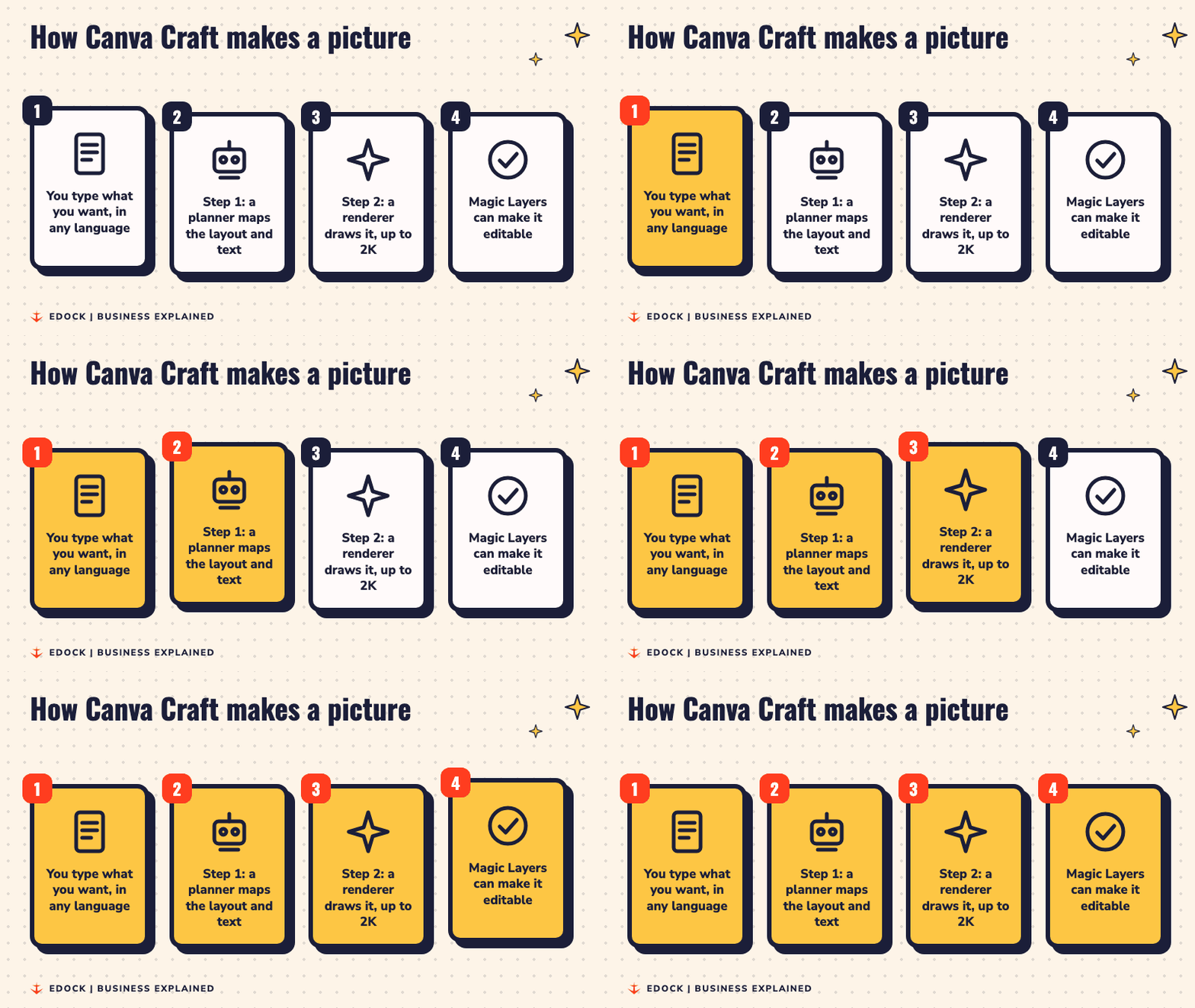
Canva also says prompts can be written in any language, and Craft can create text in 55 languages.
Trained on designs, not just photos
An AI model learns by looking at lots of examples, a bit like a student solving hundreds of past papers before an exam. Canva says most image models learn mainly from photographs. Craft learned from millions of human made templates in Canva's library: posters, social posts, presentations, infographics, menus and text heavy layouts.
That matters because a picture made by Craft can be turned into separate, editable pieces using Canva's Magic Layers. So you can move the heading or change one colour without redrawing everything.
Canva also says its designers and dozens of researchers compared more than 25,000 pairs of images against leading models while testing Craft.
How good is it?
Canva points to DesignArena, an online leaderboard where many people vote on AI designs. Canva says Craft debuted as the fourth most advanced image generation model there, and ranked first out of 87 models for People and Portraits. Based on those rankings, Canva calls its lab the world's second most advanced AI lab for image generation. These are Canva's own claims about a public leaderboard, and rankings like these can change week to week.
Who can use it?
Canva says Craft is available to all Canva users globally from launch day. You find it in Dream Lab, in the bottom left panel of the app. Digital Trends notes that access is still subject to usage limits, so nobody gets unlimited free pictures.
Other companies can also plug Craft into their own apps through Canva's API. An API is like a waiter who takes an order from one app to another and brings back the result. Canva says links to chatbots such as ChatGPT and Gemini, through a connector, are coming later.
The money reason behind it
Here is the business side. Every time someone asks an AI for a picture, a computer somewhere does heavy work, and that costs money. When Canva uses another company's model, it pays for that work, a bit like paying rent instead of owning the house.
Canva has felt that bill. In its update to investors for the April to June 2026 quarter, chief executive Melanie Perkins said the average cost of serving an AI task was too high and that Canva was relying too heavily on frontier models (the most powerful, and costly, models from the biggest AI companies). Canva cut its 2026 growth forecast from 30% to 20%.
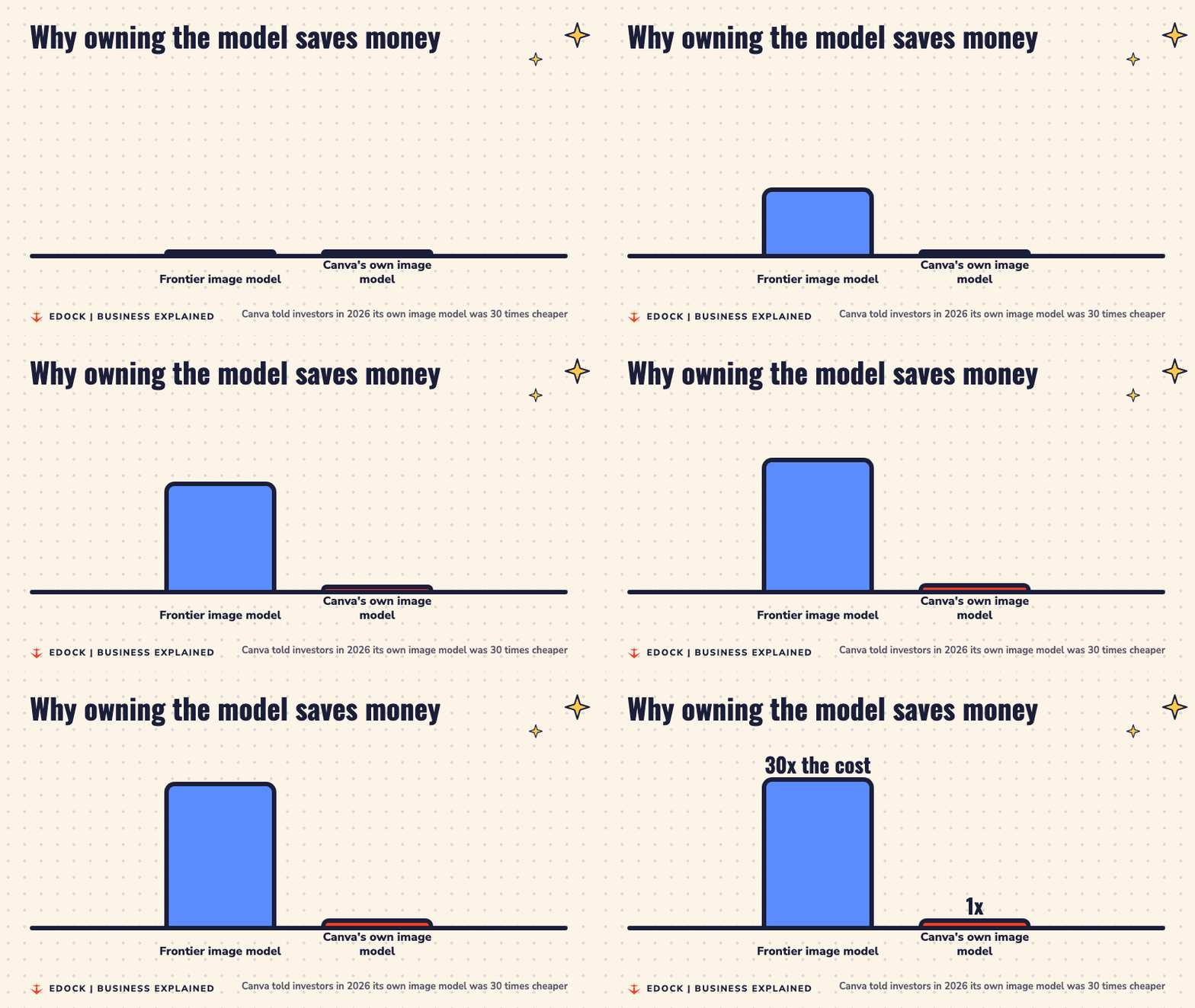
The same report says Canva cut the cost of serving an AI task by 90%, and that its own image model was 30 times cheaper than a frontier model. TechCrunch notes Craft could likely help Canva save on API costs, and Canva says it also gives better control over quality and speed.
Canva is also working on two cheaper, faster versions, Craft-fast and Craft-ultrafast, which it says will deliver images at a fraction of the cost of leading frontier models.
Who built it?
Craft comes from Canva Research, the company's in-house AI lab. A day before the launch, Canva said the lab has more than 160 AI research scientists and engineers, inside a wider AI team of 400 people. Canva bought the AI lab Kaleido in 2021 and Leonardo in 2024, and TechCrunch says researchers from Leonardo.ai helped build Craft.
The bigger picture
Canva's numbers are still large. It reached $4 billion in annual recurring revenue by the end of 2025. Annual recurring revenue is the money a company expects to earn in a year from paid plans, like a gym counting all its yearly memberships. Its revenue for the June 2026 quarter grew 25.2% to $921.9 million.
But it faces tough rivals such as Adobe, Freepik and Apple. And after the forecast cut, outside analysts reportedly valued Canva lower, from $42 billion to $35 billion. A valuation is simply what people think the whole company is worth, like guessing the price of a shop with all its stock and customers.
So Craft is two things at once. For users, it is a new tool for posters and posts with correct text. For Canva, it is a way to keep AI features cheap enough to offer to hundreds of millions of people, many of them on free plans.
Sources
- Introducing Canva Craft, Canva Newsroom
- Introducing Canva Research, Canva Newsroom
- Canva releases its first image generation model, TechCrunch
- Canva gets to $4B in revenue as LLM referral traffic rises, TechCrunch
- Canva debuts Craft image model built by its in-house research lab, Unite.AI
- Canva enters the AI image generation race with Craft, Digital Trends
- Canva cuts revenue forecast by a third as it tackles high AI costs, Startup Daily
- Cover photo: Penciling on Wacom Cintiq 13HD, by David Revoy, CC BY 4.0
