BPCL profit falls 22% as frozen petrol and diesel prices eat into earnings
Version 1 of 1 saved 24 Oct 2026, 9:32 pm IST · Chain line 216
As it was first published
BPCL profit falls 22% as frozen petrol and diesel prices eat into earnings
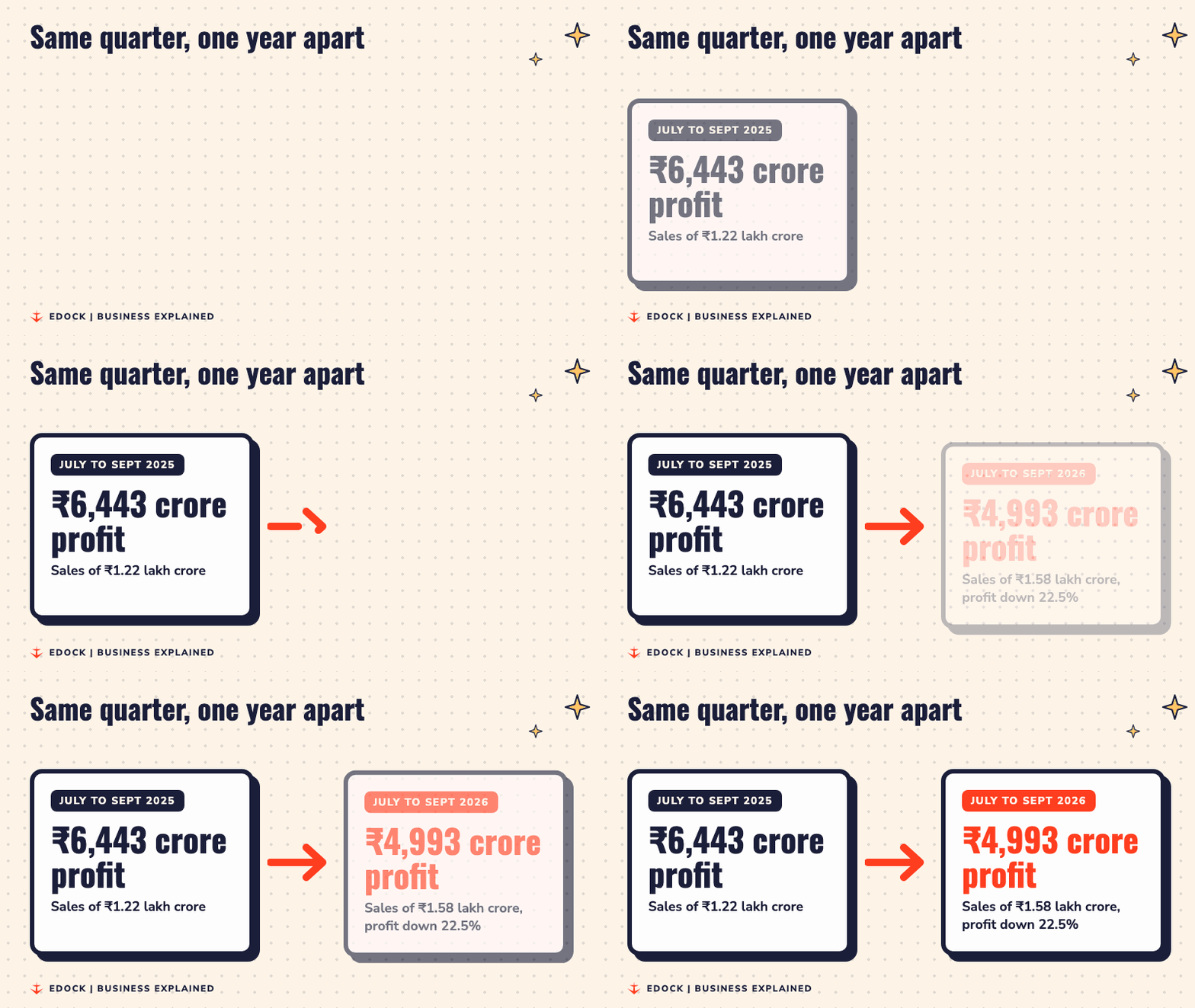
Bharat Petroleum earned ₹4,993 crore in July to September, down from ₹6,443 crore, even though its sales jumped to ₹1.58 lakh crore.
Picture a samosa stall. The price of oil doubles, but the owner is told to keep selling each samosa at the old price. More customers come, the cash box fills up, and yet the owner goes home with less money. That is roughly what just happened to one of India's biggest fuel sellers.
On 23 October 2026, Bharat Petroleum Corporation Ltd (BPCL) said its standalone net profit fell 22.5% to ₹4,993 crore for July to September, down from ₹6,443 crore a year earlier. The reason, in short: a five month old freeze in retail fuel prices even as costs rose.
First, who is BPCL?
BPCL is a state-owned company, which means the government owns it, not a private family or founder. It is India's second-largest oil marketing company. It runs refineries in Mumbai, Kochi and Bina, and has more than 25,300 fuel stations and over 6,250 cooking gas (LPG) distributors across the country.
Two profit numbers, which one is right?
News reports show two different figures, ₹4,993 crore and ₹4,863 crore. Both are correct. They just measure different things.
- Standalone profit is BPCL on its own, like counting only the money in one shop's cash box. That is ₹4,993 crore, down 22.5%.
- Consolidated profit adds the results of the other companies BPCL owns or shares, like counting the cash of the whole family of shops together. That is ₹4,863 crore, down 21.5% from ₹6,191 crore.
This post uses the standalone number unless it says otherwise. In plain money terms, BPCL's own profit shrank by ₹1,450 crore compared with the same three months last year.
Sales went up, so why did profit go down?
Here is the strange part. BPCL's revenue rose to ₹1.58 lakh crore from ₹1.22 lakh crore. Revenue is all the money that comes in from selling things, before paying any bills. So BPCL sold a lot more, in rupees.
But its costs grew even faster. The Hindu reported that the cost of raw materials used jumped 44.2% to ₹74,969 crore in the quarter. When the bill for raw material grows faster than the money coming in, the profit gets squeezed.
The company itself put it simply. It said the lower profit was "mainly due to suppressed marketing margin on certain petroleum products", partly made up for by higher refining margin.
Two kinds of margin, explained with a stall
An oil company like BPCL earns money in two main steps.
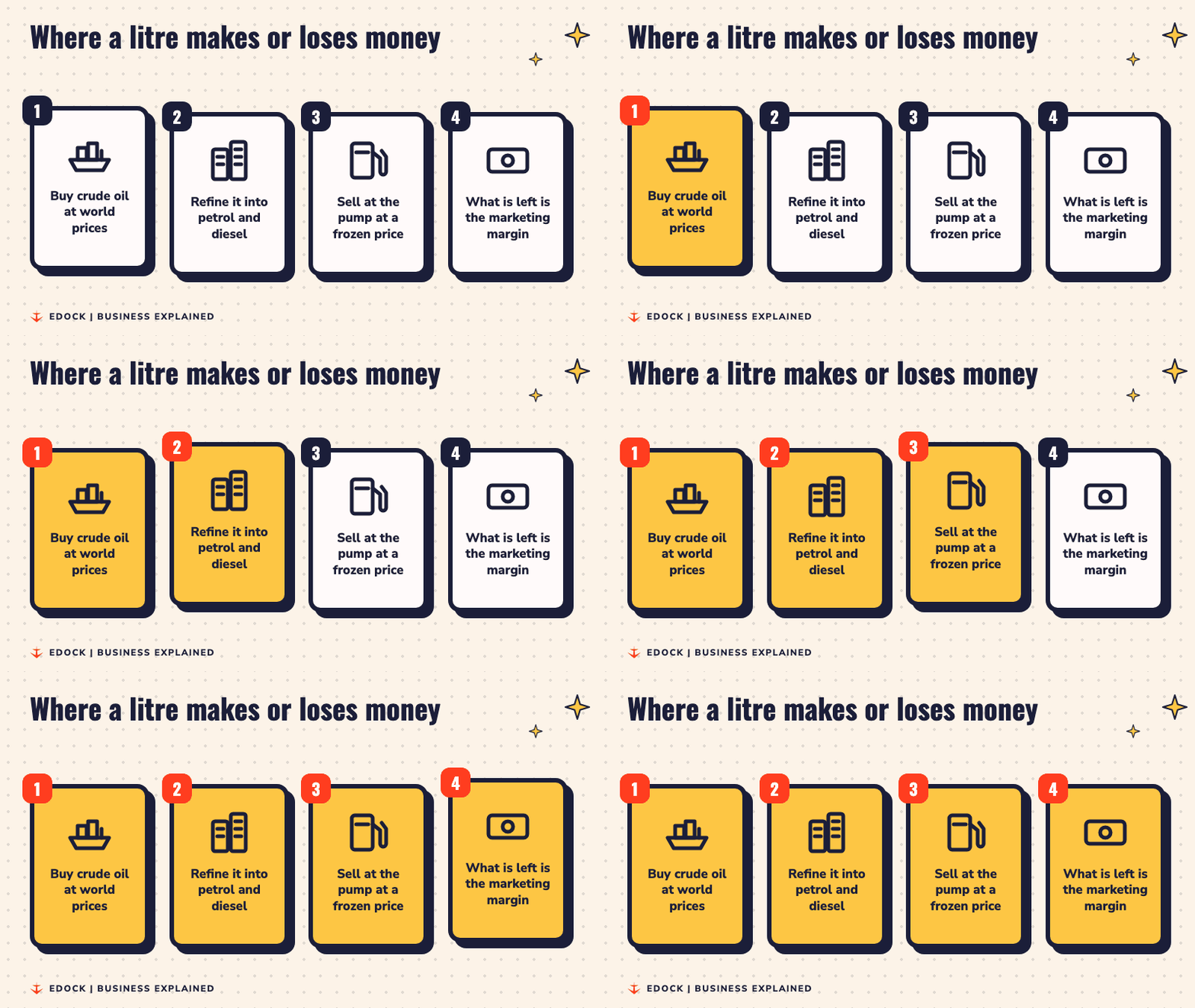
Step one: refining. It buys crude oil, which is thick, raw oil from the ground, and cooks it into petrol, diesel and other fuels. The money it makes on each barrel in this step is called the refining margin.
Step two: marketing. It sells those fuels at its pumps. The money left on each litre after paying for the fuel is the marketing margin. Think of a samosa stall: the marketing margin is what stays in the owner's pocket after paying for the dough, potatoes and oil.
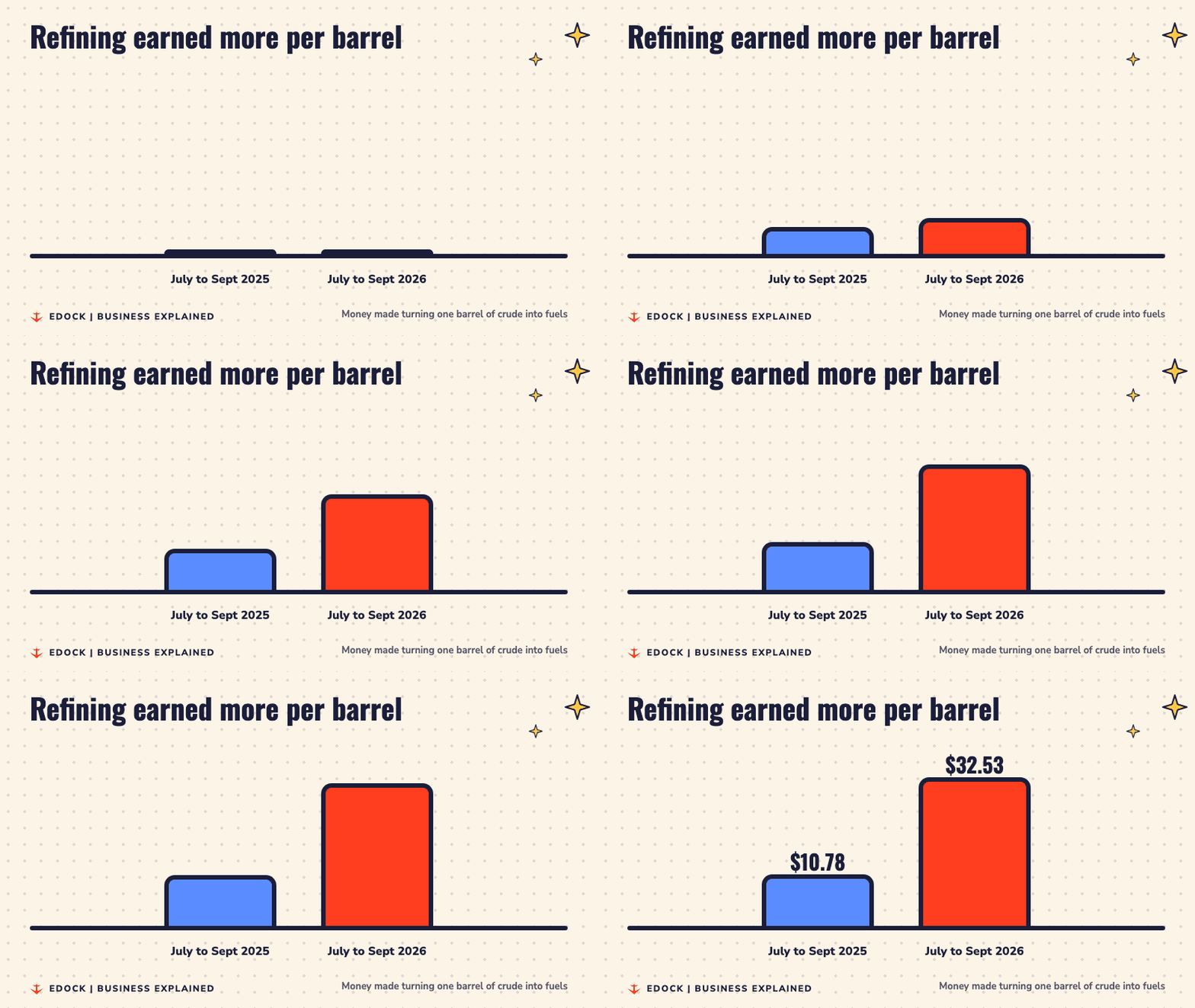
This quarter, step one went very well. BPCL earned $32.53 on every barrel it refined, compared with $10.78 a year earlier. That is about three times as much.
But step two went badly. According to the same report, those refining gains were wiped away by losses from the price freeze. BPCL also booked a ₹330 crore loss on the value of its fuel stock and a ₹397 crore loss from changes in the rupee's exchange rate.
Why have pump prices not moved?
Earlier this year, crude oil prices crossed $100 a barrel. State-run fuel companies did not raise petrol and diesel prices until early May. Then they raised prices four times in May, adding ₹7.38 a litre to petrol and ₹7.52 a litre to diesel.
Since then, retail prices have stayed where they were, even as costs kept rising. So every litre sold carried a thinner margin. It is like the samosa stall that already raised its price once and now cannot raise it again, even though oil keeps getting costlier.
That freeze hit hard earlier too. In April to June, BPCL made a consolidated loss of ₹1,872.70 crore. So July to September is actually a return to profit, just a smaller one than last year.
This short video explains how the price you pay at a pump is put together:
The cooking gas story
Cooking gas is another pressure point. When a company sells an LPG cylinder for less than it costs, the gap is called an under-recovery. Think of it as money a shop is still waiting to get back.
As of 30 September, BPCL's under-recovery on LPG stood at ₹17,334.40 crore. The oil ministry has approved ₹7,594 crore as compensation, paid in 12 equal monthly parts. BPCL counted six of those parts, worth ₹3,796.98 crore, in this period.
The refineries ran flat out
BPCL's plants were busy. Its refineries processed 10.41 million tonnes of crude oil, running at 118% of capacity, up from 9.82 million tonnes a year ago. Running above 100% means the plants worked harder than their official rated size. Fuel sales inside India rose to 13.47 million tonnes from 12.67 million tonnes.
The company also said its board approved a separate company to run a planned 10 million tonne a year refinery and petrochemical complex at Ramayapatnam in Andhra Pradesh, subject to government approvals. It did not give the cost or a timeline.
What this means for you at the pump
For now, the person filling a scooter tank pays the same price as in the last few months. The cost of that steady price is being carried, in part, by companies like BPCL through thinner margins.
For students learning business, this is a neat lesson: bigger sales do not always mean bigger profit. What matters is the gap between what something costs you and what you can charge for it. When that gap shrinks, a company can sell more and still earn less.
Its peer Indian Oil is set to post its September quarter results on 30 October. That will show whether the same squeeze hit the whole industry.
Sources
- Business Standard (PTI): BPCL Q2 profit falls 22.5% as fuel price freeze hits earnings
- Business Standard: BPCL Q2 net profit falls 21.5% on weak marketing margins
- BusinessLine: BPCL Q2 profit falls 22% as EBITDA slips on fuel price freeze
- The Hindu: Bharat Petroleum's net profit dips amid volatile crude prices in Q2
- Moneycontrol: BPCL consolidated net profit falls 21% to ₹4,863 crore in Q2FY27
- Cover photo: Bharat Petroleum fuel filling station, Mumbai, by Manukrishnan80, CC BY-SA 3.0
