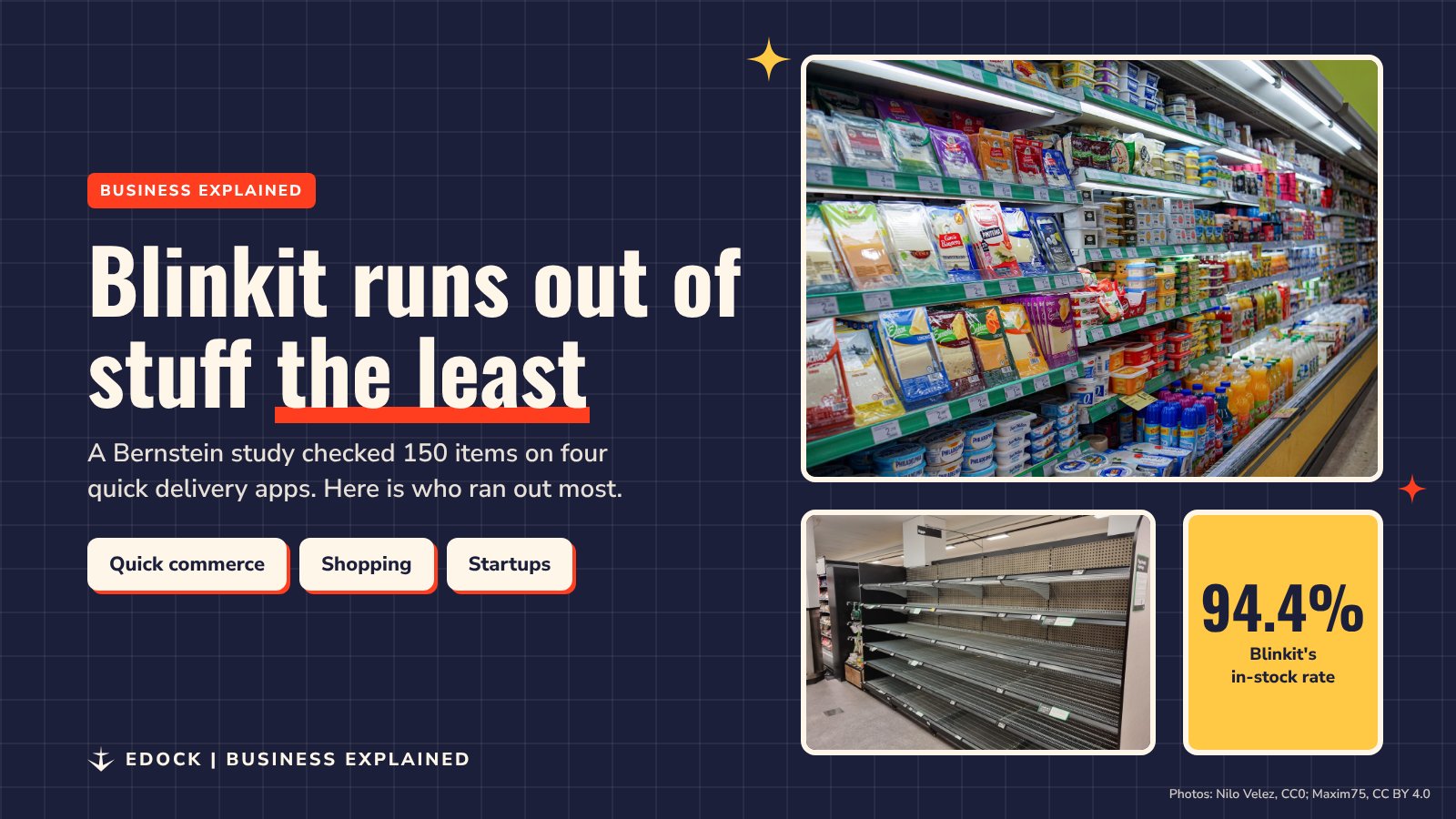
Blinkit had 94 of every 100 items in stock. Its rivals ran out more
A Bernstein study checked 150 items on Blinkit, Flipkart Minutes, Instamart and Zepto. Here is who ran out, and why it matters.

Picture this. It is late at night, and you want your favourite chips. You open a quick delivery app, find them, and tap. Then you see two sad words: Out of stock.
A new study tried to find out how often that happens on India's big 10-minute delivery apps. It was done by Bernstein. Entrackr reported it on October 8, 2026, and Business Today on October 11. The winner: Blinkit, which had items in stock 94.4% of the time.
Let us see what the study checked, who came where, and why it matters.
First, some simple words
Quick commerce means apps that bring groceries and daily items to your door in minutes. Blinkit, Zepto, Swiggy Instamart and Flipkart Minutes are the big names.
Bernstein is a brokerage. That is a firm that studies companies and shares reports with investors.
An SKU (stock-keeping unit) is one exact product. A small packet of chips and a big packet of the same chips are two different SKUs.
The in-stock rate tells you how often an item was there when someone checked. If it is 94%, then out of every 100 checks, the item was there about 94 times.
What did Bernstein check?
According to Business Today, Bernstein:
- Tracked 150 SKUs, across groceries, fresh items and non-grocery things.
- Checked for 10 days, at seven times each day.
- Looked at no fewer than three PIN codes in each of Mumbai, Gurugram and Bengaluru.
So it is like a class monitor visiting four canteens, again and again, with the same list of 150 snacks.
The scoreboard
Here is the average in-stock rate for each app:
- Blinkit: 94.4%
- Flipkart Minutes: 88.7%
- Swiggy Instamart: 83.8%
- Zepto: 82.5%
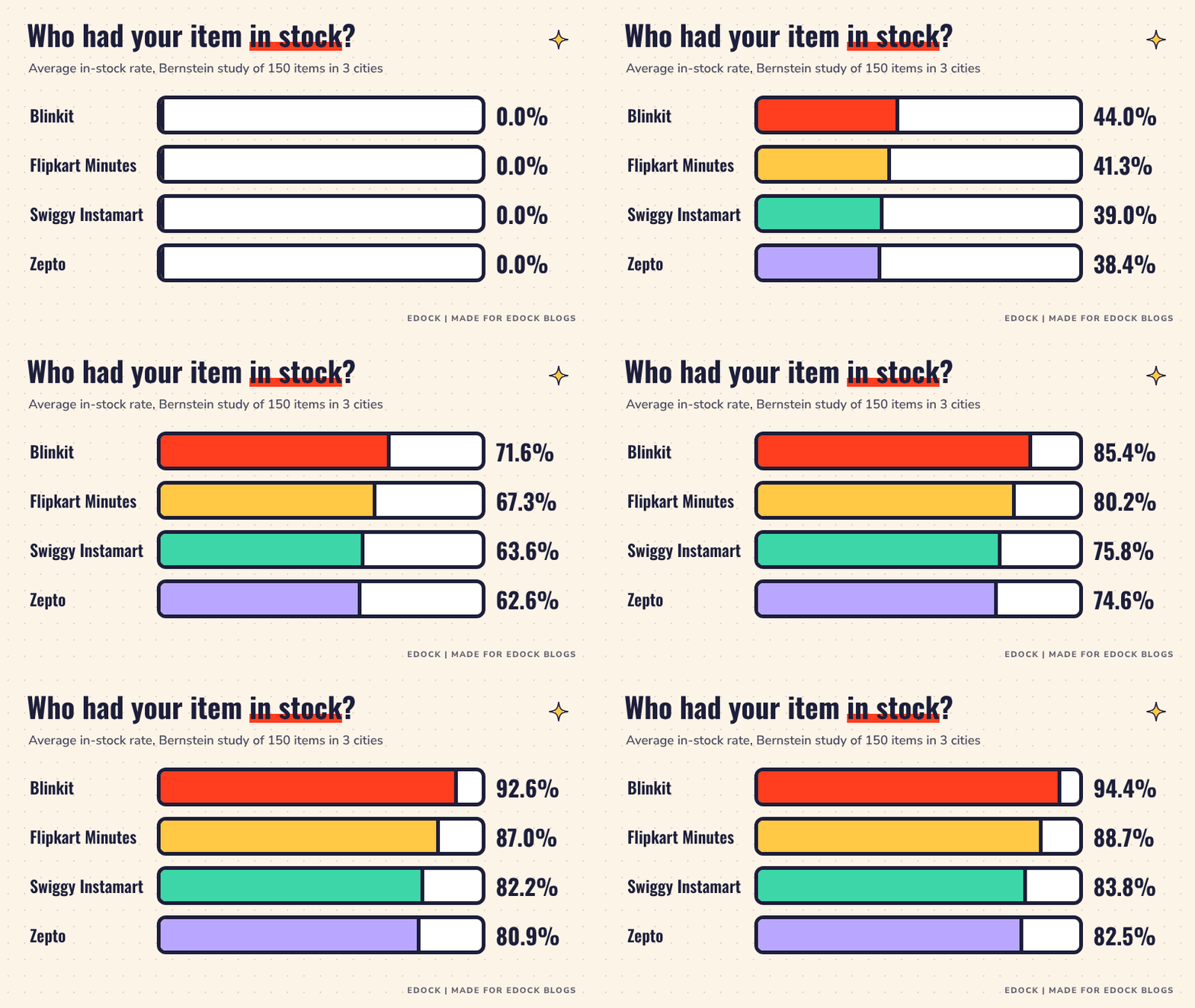
Blinkit was 5.7 percentage points ahead of Flipkart Minutes, and 11.9 points ahead of Zepto. A percentage point is simply the gap between two percentages. From 82.5% to 94.4% is a gap of 11.9 points.
Put simply: if you ordered 100 items, Blinkit would have about 94 of them. Zepto would have about 82 or 83.
Steady or shaky?
Blinkit stayed at about 94% to 95% for the whole study, Business Today says. Instamart and Zepto went up and down more. At some times, they dropped below 80%.
That is like a batter who scores 40 runs in every match, compared to one who scores 70 one day and 10 the next. Shoppers like the steady one.
Why do shelves get emptier at night?
The study also found that items ran out more as the day went on. According to Entrackr, availability fell during the day by:
- 11% on Instamart
- 6% on Zepto
- 5% each on Blinkit and Flipkart Minutes
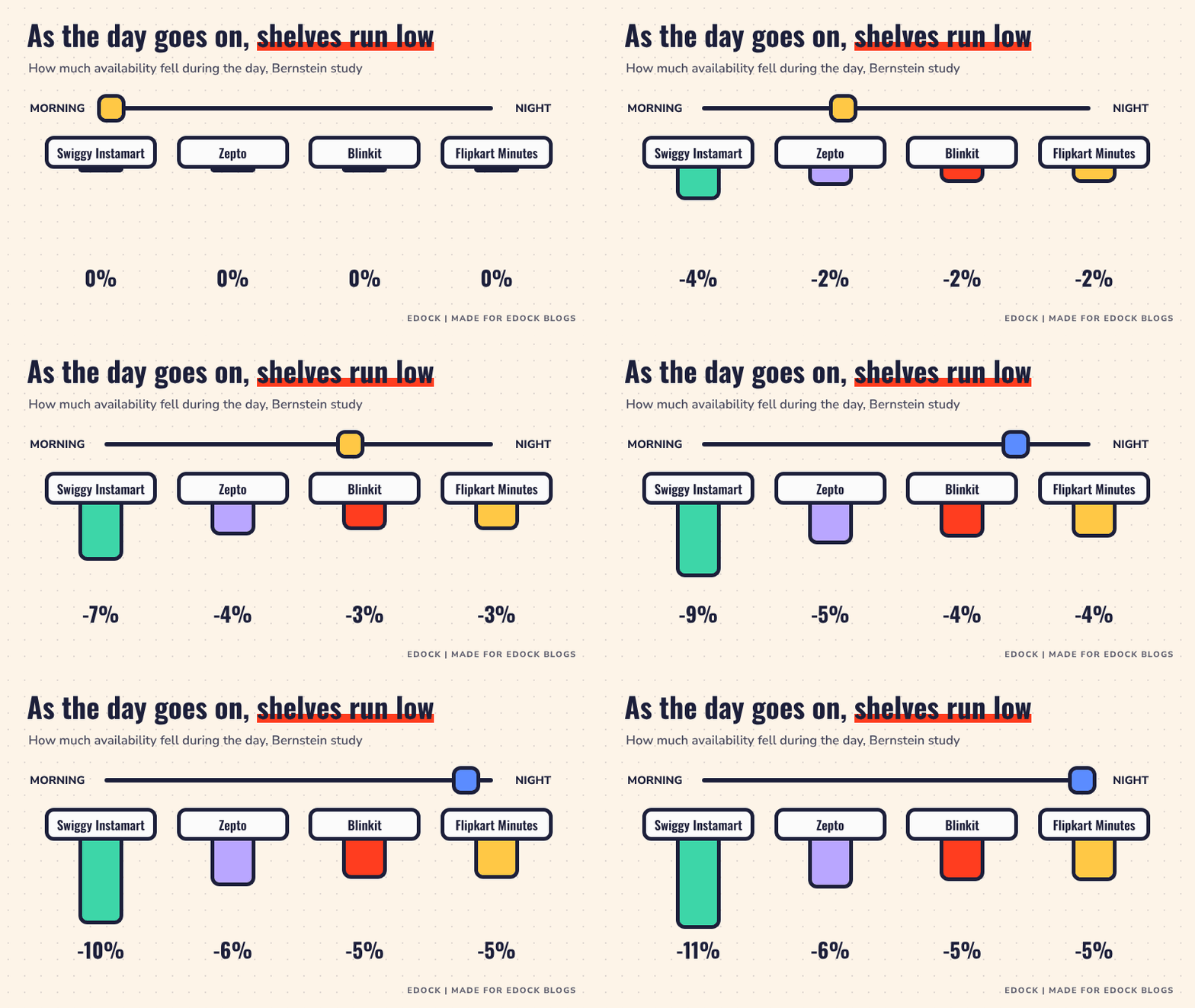
Bernstein said Instamart's bigger drop came from trouble with demand forecasting and refilling stock.
Think of a samosa stall. In the morning, the owner guesses how many samosas will sell by evening. That guess is demand forecasting. If the guess is too low, the samosas run out by 6 pm. Then the owner has to rush to make more. That is refilling, or replenishment. Get either one wrong, and hungry customers walk away.
What is a dark store?
These apps send your order from dark stores. A dark store is a small warehouse near your home, full of shelves, where you cannot walk in to shop. Workers pack your order there, and a rider rushes it to you.
Blinkit had 2,443 dark stores at the end of June 2026, after adding 200 in just three months, Inc42 reported.
Why being in stock matters so much
Until now, these apps fought mainly on two things: who delivers faster and who is cheaper. Now, having the item at all is becoming a big way to win, Entrackr notes.
Bernstein believes Blinkit's lead could help it keep customers and reduce churn. Churn means customers leaving for a rival. Imagine you go to the same chai stall every day. One week, it keeps running out of milk. So you try the stall next door, and you never come back. That is churn.
Bernstein also says customers like apps that can deliver their whole basket. Nobody wants to order from two apps just to get milk and bread.
Keeping stock is not free
Packing shelves full has a cost. Some items expire, break, or go missing. Inc42 says Blinkit's inventory losses were about 1.8% of its net order value in April to June 2026.
Net order value is the total value of orders placed on the app. For Blinkit, it was ₹17,132 crore in those three months. So 1.8% of that works out to roughly ₹308 crore of lost stock.
Flipkart Minutes is moving fast
Flipkart Minutes came second in the study. Business Today says it has now passed Instamart in the number of dark stores and PIN codes it covers in India's top 10 cities.
All the apps are also adding more things beyond groceries, like electronics, beauty products and festive gifts.
Bernstein has been watching Blinkit for a while. In this earlier ET Now video, a Bernstein analyst talks about Blinkit's growth.
A small warning about this study
The study only checked 150 items, in three cities, at certain times of day. So the results may be different in your city or your area. Your own app might do better, or worse.
The short version
- Bernstein checked 150 items on four quick delivery apps for 10 days.
- Blinkit had items in stock 94.4% of the time, the best of the four.
- Instamart and Zepto ran out more, especially later in the day.
- Apps now compete not just on speed and price, but on having your item at all.
Sources
- Business Today: Blinkit leads India's quick commerce race in product availability
- Entrackr: Blinkit leads quick commerce in product availability, Flipkart Minutes ranks second
- Inc42: Blinkit's Q1 adjusted EBITDA rises to ₹102 Cr
- Cover photos: A supermarket aisle with shelves filled with various dairy products, by Nilo Velez, CC0 1.0; Empty eggs shelf in the Australian supermarket, by Maxim75, CC BY 4.0

You may republish this story under CC BY 4.0: credit Pranav Sharma and link to this page.