Bewakoof sold 40% more, but lost more money. Here is why
Sales jumped to ₹243 crore and the loss grew to ₹87.4 crore. Explained in super easy words, with lemonade and samosas.


Picture this. Your favourite T-shirt shop just had its best year in a long time. More people bought more clothes than ever before. The shop made lots more money from sales.
And yet, at the end of the year, it lost more money than the year before.
Sounds strange? That is exactly what happened to Bewakoof, the clothing brand many young Indians know for its funny T-shirts. Its numbers for the year that ended in March 2026 were filed with the government and reported on 29 September 2026. Sales went up by 40%. The loss went up too.
So how can a company sell more and still lose more? Let us break it down, step by step.
First, what is Bewakoof?
Bewakoof started in 2012. It sells T-shirts, joggers, bags, notebooks and other things, mostly to millennials and Gen Z. In other words, people like you.
Today Bewakoof is owned by a much bigger company. TMRW, a part of Aditya Birla Fashion and Retail, bought a majority stake in it. The deal was reported at ₹200 crore and completed in February 2023. "Majority stake" means owning more than half of the company, so the owner gets the final say.
The company says its app has more than 10 million users. Its founder, Prabhkiran Singh, decided to step down in 2026, after about 14 years of running the brand.
Two words you need to know
Before the numbers, two simple words.
- Revenue is all the money that comes in from selling things. If you sell 10 cups of lemonade for ₹20 each, your revenue is ₹200.
- Profit is what is left after you pay for everything: the lemons, the sugar, the cups and the table. If all that cost ₹150, your profit is ₹50. If it cost ₹250, you have a loss of ₹50.
So revenue is how much you sell. Profit or loss is what you keep, or lose, after paying the bills. A company can have big revenue and still make a loss.
The big numbers
Here is what changed in one year, as Entrackr reported from the company's filings:
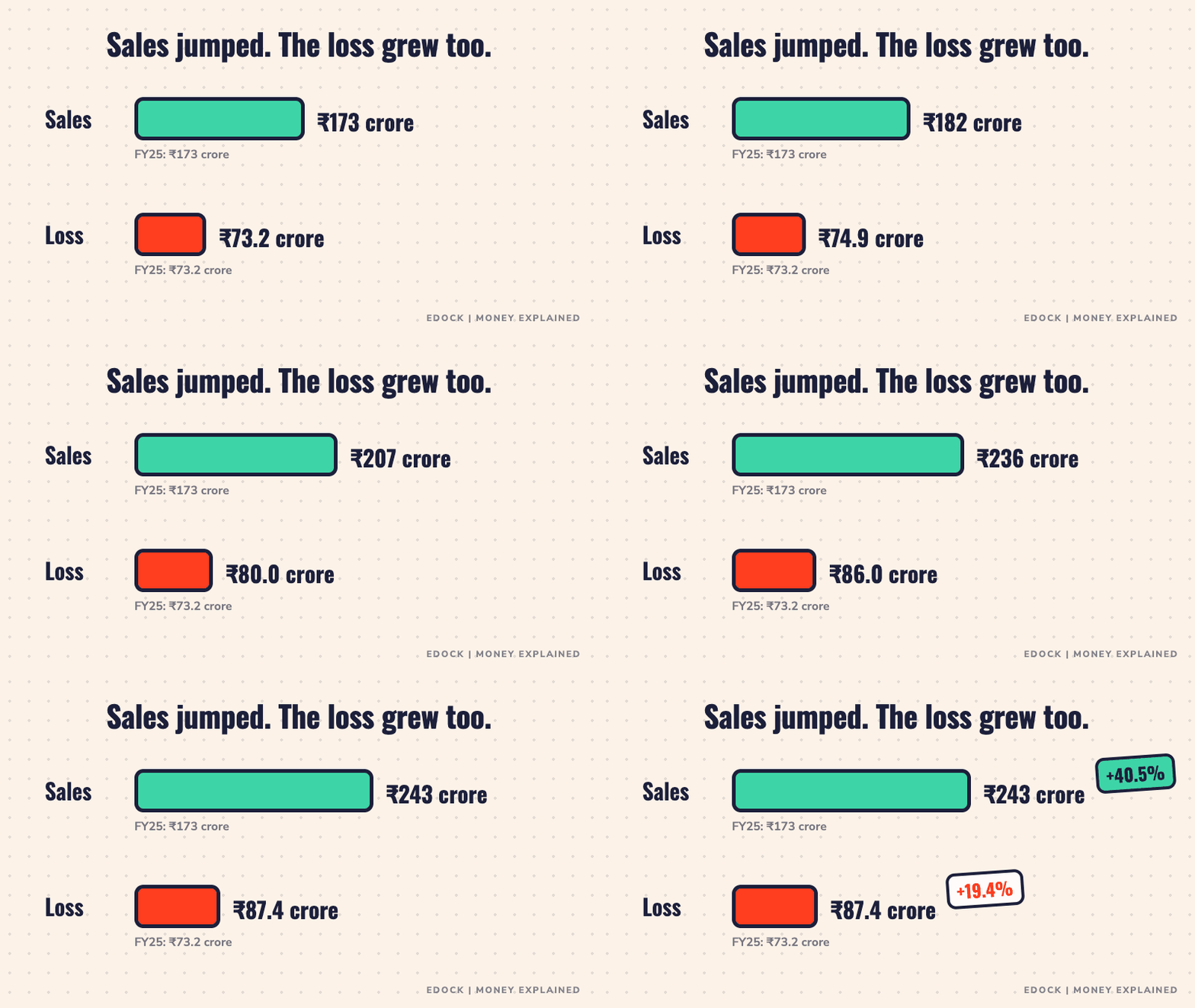
- Revenue from selling things grew from ₹173 crore to ₹243 crore. That is a jump of 40.5%.
- The loss grew from ₹73.2 crore to ₹87.4 crore. That is 19.4% more.
To feel how big ₹243 crore is: it is about the same as selling 24 lakh T-shirts at ₹1,000 each.
Where did all the money go?
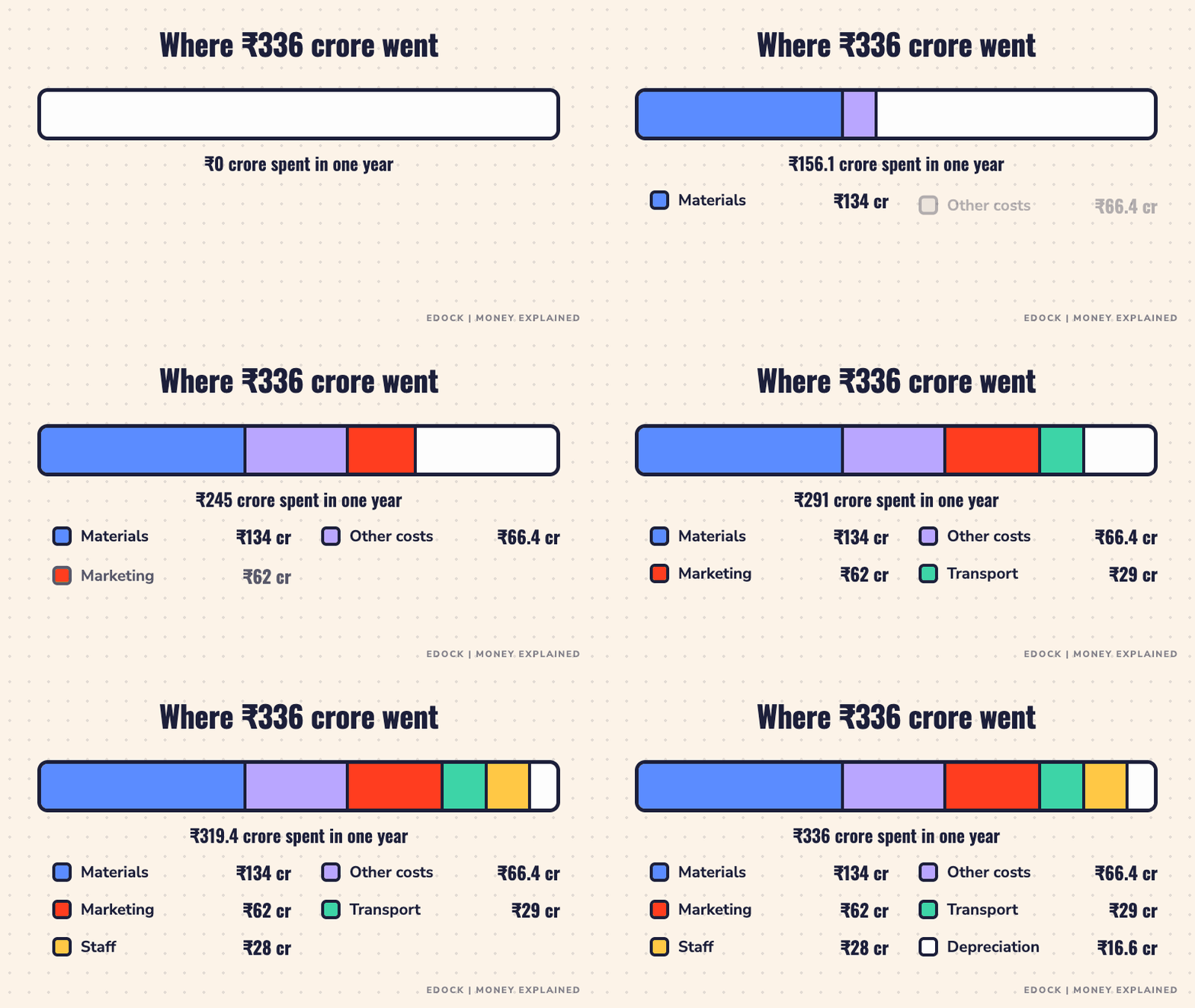
Bewakoof spent ₹336 crore in the year, 35.5% more than the year before. Here is where most of it went:
- Materials, ₹134 crore. This is the cloth, thread and everything else needed to make the clothes. It was the biggest cost, and it went up 45.7%. More sales means more T-shirts to make.
- Marketing, ₹62 crore. Ads, posts and campaigns that tell you to buy. Up 26.5%.
- Other costs, ₹66.4 crore. A big mix of running costs. Up 66.1%.
- Transport and handling, ₹29 crore. Getting parcels to your door. This one actually went down, by 17.1%.
- Staff, ₹28 crore. Salaries for the people who work there. Up 7.7%.
- Depreciation, ₹16.6 crore. Nearly three times the ₹6 crore of the year before.
Depreciation is a tricky word with a simple idea. Say you buy a new phone for ₹30,000 and it lasts three years. Each year, a bit of that phone gets "used up". Companies count that slowly used-up value as a cost every year. When a company buys or builds more things, like stores, machines or software, this number goes up.
The ₹1.38 puzzle
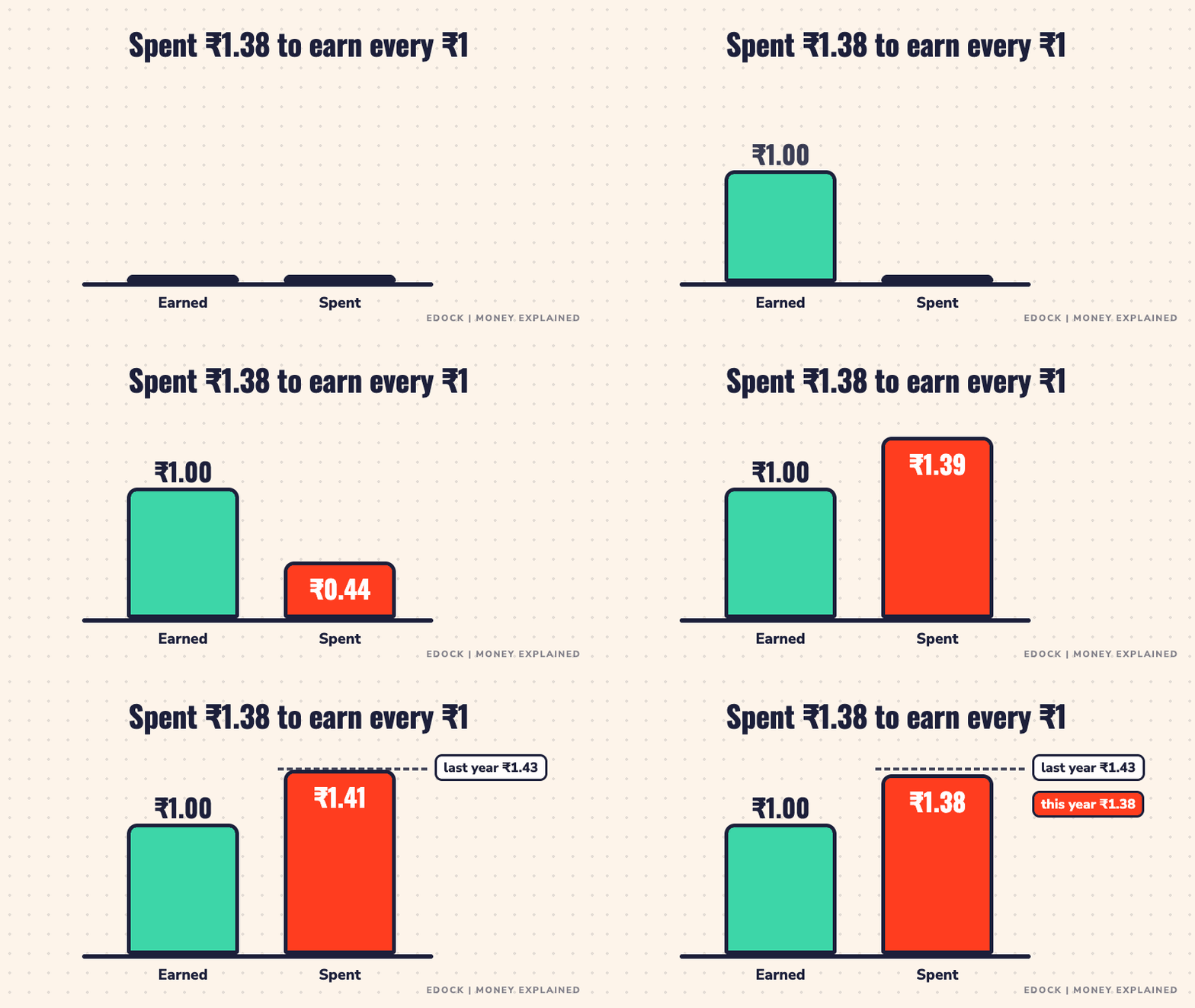
Here is the clearest way to see the problem. For every ₹1 Bewakoof earned from sales, it spent ₹1.38.
Imagine running a samosa stall where each samosa sells for ₹10, but making it, packing it and telling people about it costs ₹13.80. The more samosas you sell, the more money you lose, unless you bring that cost down.
But there is good news hiding here. A year earlier, Bewakoof spent ₹1.43 for every ₹1. So the gap is getting smaller. It is still losing money on each rupee, just a little less than before.
Wait, is anything getting better?
Yes, a few things.
Business reporters often look at something called EBITDA. It is a long name for a simple idea: how the day-to-day business is doing before a few accounting items, like depreciation, are counted. Bewakoof's EBITDA loss went from ₹60.7 crore to ₹59.8 crore. A small step, but the right direction.
Another way to say it: the EBITDA loss used to be about 35 paise of every rupee of sales. Now it is about 25 paise. Sales grew much faster than this loss did.
So the main business is slowly getting healthier. Most of the extra total loss came from depreciation, which jumped from ₹6 crore to ₹16.6 crore.
Why would a company grow like this?
Some young companies choose to grow first and make a profit later. It is a bit like a cricket team that spends a season training new players. It may lose more matches now, hoping to win more later.
Having a big owner like Aditya Birla Fashion and Retail can help, because a brand that is losing money needs someone to fund it while it grows. But no company can lose money forever. Sooner or later, the ₹1.38 has to become less than ₹1.
For Bewakoof, the next year will show whether growing fast now was the right bet.
What you can learn from this
- Big sales do not mean big profit. Always ask what it cost to make those sales.
- Look for the direction. A loss that is shrinking compared with sales can be a good sign, even if the total loss grows.
- Every cost tells a story. Materials grow when sales grow. Marketing grows when a brand wants attention. Depreciation grows when a company builds things.
Next time you buy a T-shirt online, think about the cloth, the ad that showed it to you, the delivery to your door and the people who made it all happen. All of that has to cost less than what you paid, or the company loses money.
Sources
- Bewakoof's revenue jumps 40% to Rs 243 Cr in FY26, losses rise 19% (Entrackr, 29 September 2026)
- Bewakoof Revenue Climbs 40% to Rs 243 Cr in FY26 as Losses Rise 19% (Apparel Resources, 30 September 2026)
- Bewakoof Narrows FY25 Loss By 29% To INR 73.2 Cr (Inc42)
- Bewakoof Founder Prabhkiran Singh To Step Down (Inc42)
You may republish this story under CC BY 4.0: credit Pranav Sharma and link to this page.