ASML makes the machines behind AI chips. It cannot build enough till 2028
Version 1 of 1 saved 15 Oct 2026, 6:41 am IST · Chain line 27
As it was first published
ASML makes the machines behind AI chips. It cannot build enough till 2028
The Dutch company sold a record €11.7 billion in three months, and some customers already want machines for 2030.
Picture a bakery so popular that customers are already asking to book cakes for 2030. Now swap the cakes for giant machines that print computer chips. That is where a Dutch company called ASML is right now.
On October 14, 2026, ASML shared its results for the three months that ended in late September. It made a record €11.7 billion in sales. That is about 13.1 billion US dollars. And yet, it said it will not be able to make enough machines for its customers in 2027 and 2028.
Wait, what does ASML make?
ASML does not make chips. It makes the machines that make chips. Its customers include TSMC, Samsung, SK Hynix, Micron and Intel, the companies that build chips for phones, laptops and AI computers.
ASML is the only company that makes the most advanced machines of this kind. They do a job called lithography. It is a fancy word for printing with light.
Printing with light, like a rangoli stencil
Have you ever made a rangoli with a stencil? You hold the stencil over the floor, sprinkle colour, lift it, and the pattern stays behind.
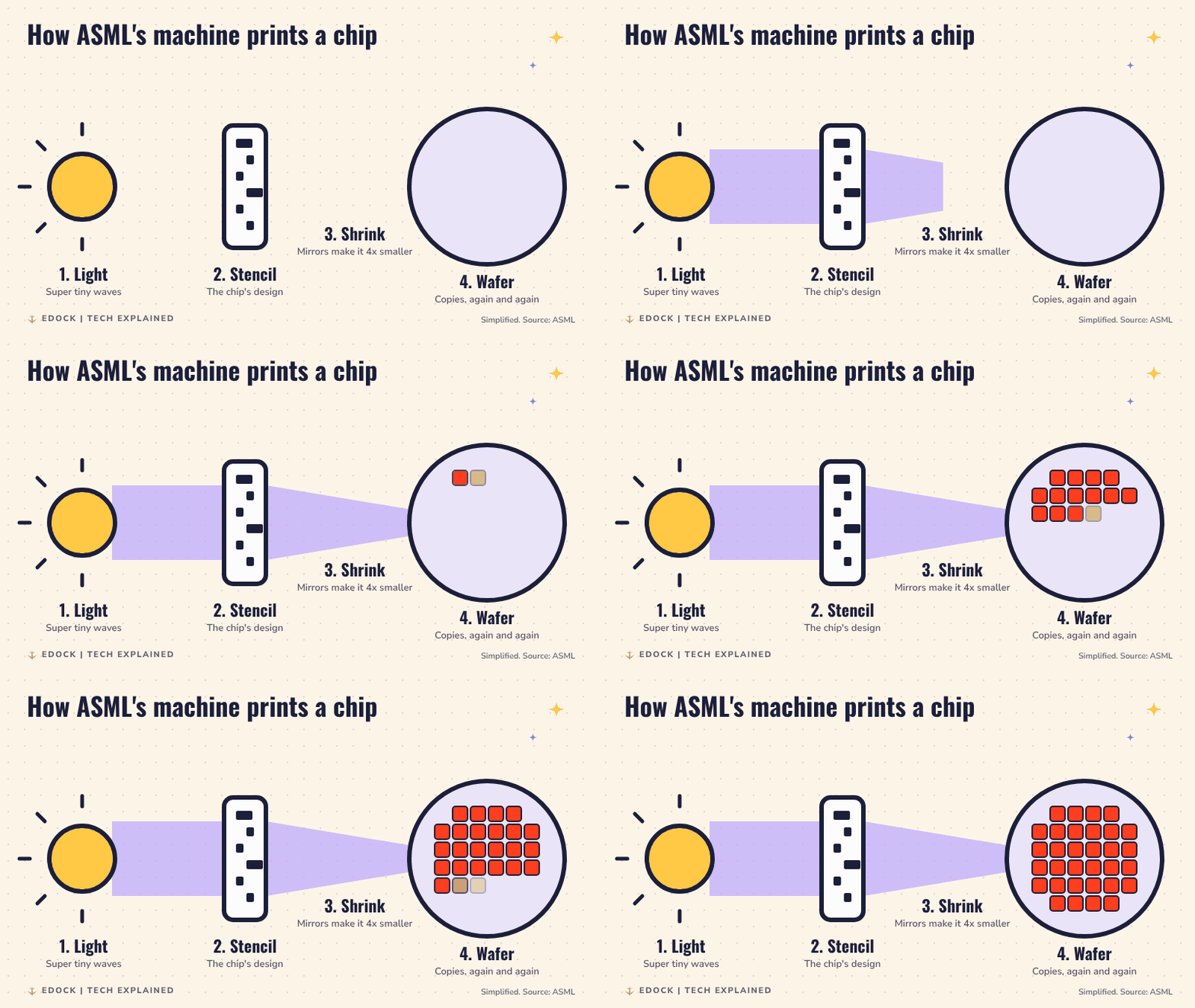
ASML's machines work in a similar way, but with light. Light shines through a blueprint of the chip, called a mask. The machine shrinks the pattern and focuses it onto a thin, round slice of silicon, called a wafer. Then it moves the wafer a little and prints the same pattern again, and again.
Chips are built up layer by layer like this. A top chip has billions of transistors. A transistor is a tiny on and off switch.
The light is the magic part
ASML's best machines use EUV light. EUV is short for extreme ultraviolet. Its waves are just 13.5 nanometres long, almost in X-ray range. A nanometre is one billionth of a metre, far too small to see.
Smaller waves can print smaller details, just like a thin pen draws finer lines than a fat marker. ASML says some of its EUV machines print details just 13 nanometres wide, which machines using older kinds of ultraviolet light cannot reach.
Making this light sounds like science fiction. A laser fires two pulses at a fast-moving drop of tin. The tin turns into vapour and gives off EUV light. This happens up to 50,000 times every second.
EUV light is so tricky that normal lenses do not work. So the machines use special mirrors to guide it, and they shrink the pattern four times on its way to the wafer.
If you have a fairly new smartphone, a recent gaming console or a smart watch, ASML says you have likely used something made with EUV.
The numbers from this quarter
A quarter is a three-month block of the year. Big companies share results every quarter, like a report card that comes four times a year. Here is ASML's:
- Sales: €11.7 billion, up from €9.3 billion in the quarter before. That is a jump of about 25% in three months.
- New machines sold: 113, up from 86.
- Profit: €5.0 billion, up from €2.9 billion.
- Gross margin: 57.5%.
Gross margin shows how much is left from sales after paying the cost of what was sold. A 57.5% gross margin means that from every €100 of sales, about €57.50 was left. Other costs, like research and offices, come out of that.
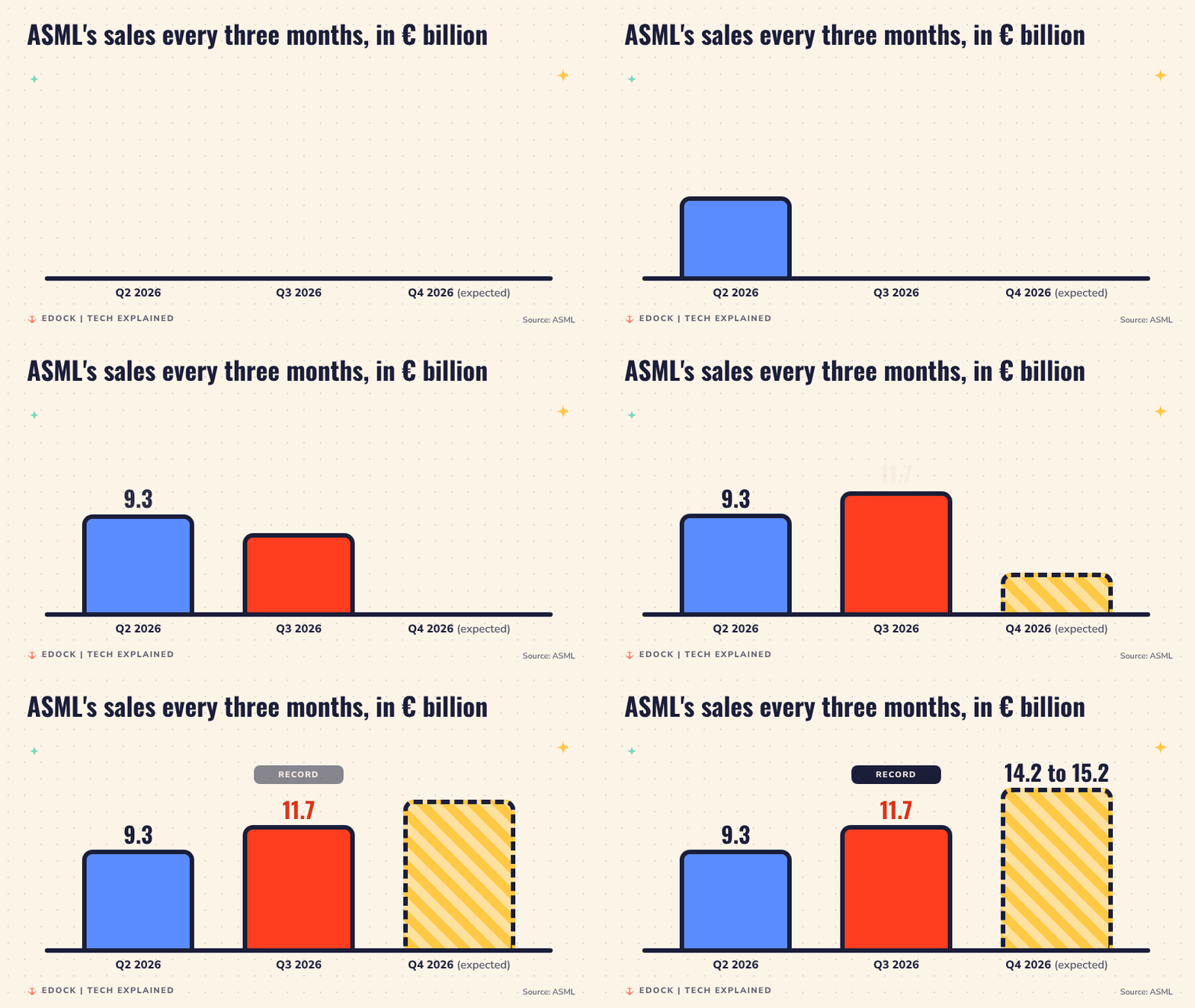
ASML expects even more in the last quarter of 2026: between €14.2 billion and €15.2 billion. For the whole of 2026, it expects €44 billion to €45 billion.
Why customers want machines for 2030
The short answer is AI. ASML's chief executive, Christophe Fouquet, said customers keep raising how much equipment they want, "driven primarily by their views on the size and duration of AI-related investments."
In simple words: companies are spending big on AI. AI runs on powerful chips. More chips need more chip factories, and the most advanced chip factories need ASML's machines.
So some customers are now showing interest in placing orders for 2029 and even 2030. That is like trying to book IPL final tickets years before the season starts. On a call with investors, Fouquet said there is also "a lot of order intake for 2028", which means a lot of orders are already coming in for that year.
So why not just build more machines?
ASML is trying. Its earlier plan was to grow its capacity, which means how many machines it can make in a year, by 30% in 2027. It was also looking at another 30% rise in 2028.
Now ASML says even that will not fully meet demand. It is looking for ways to grow beyond that 30% for 2028. In September, it also started building a second big campus in the Brainport region of the Netherlands, as per Silicon Republic.
But these are not simple machines. A samosa stall can fry an extra batch when the queue gets long. A chip machine maker cannot just do the same overnight.
Watch: what ASML said
Why does this matter?
Almost every phone, laptop and AI app runs on chips. ASML's results are one of the clearest signs of how much money is going into AI right now.
Its customers are planning chip factories years ahead, and they want a place in the queue. For ASML, the problem is not finding buyers. It is making machines fast enough.
ASML makes the machines that print the world's most advanced chips. Thanks to AI, it has more buyers than machines.
Sources
- ASML: Q3 2026 results press release (filed with the US SEC)
- ASML: EUV lithography systems
- ASML: Lithography principles
- Silicon Republic: AI-led demand overwhelms ASML's 2027, 2028 supply capacity
- DIGITIMES: ASML's record 3Q26 sales expose a capacity gap
- Cover photo: Silicon Wafer 20200519, by Rob Bulmahn, CC BY 2.0
