Apollo's top economist says AI has made zero money for most US companies
Torsten Slok checked 493 big American firms outside tech. Sales per worker and profit margins are flat, even as the tech giants pour billions into AI.


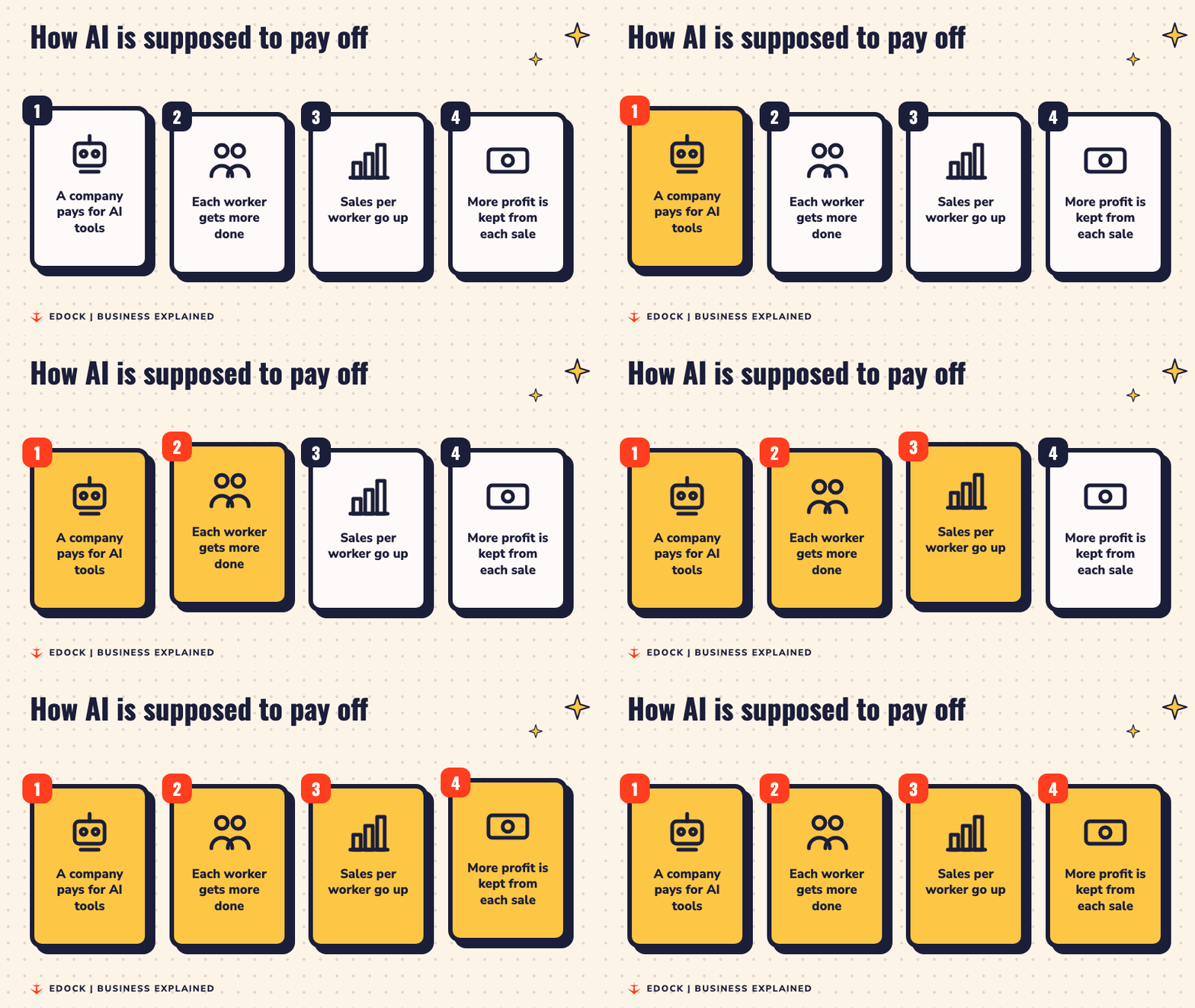
Picture the biggest companies in America spending huge sums on AI for three years. Now picture one of Wall Street's best-known economists looking at their numbers and saying the payoff, for most of them, is zero.
That is what happened on 24 October 2026. Torsten Slok, the chief economist at the investment firm Apollo Global Management, published a short note titled "No Signs of AI Payoff Outside the Tech Sector". In it he wrote that AI "has delivered zero financial payoff to corporate America outside of tech." TechCrunch reported the note on 25 October.
Here is what he looked at, what the other side says, and why it matters to young people in India.
Who is Torsten Slok, and what is Apollo?
Apollo is a private equity giant. Private equity firms collect money from big investors and use it to buy and run companies, a bit like a group of friends pooling pocket money to buy a samosa stall and make it bigger. Slok is a partner and the chief economist at Apollo. His job is to study the economy and explain where money is moving.
What is the "S&P 493"?
The S&P 500 is a list of 500 of the largest companies in America. Think of it as the playing eleven of the US business world, only much bigger. Seven of those companies are the tech giants: Alphabet (Google's parent), Amazon, Apple, Meta, Microsoft, Nvidia and Tesla. People often call them the "Magnificent Seven".
Slok took those seven out. What is left he calls the "S&P 493". These are banks, shops, carmakers, airlines, food companies and many more. In other words, the companies that use AI rather than build it.
The three numbers he checked
Slok compared the two groups on three things. The Apollo note shows each one with a chart.
- Revenue per worker. Revenue is all the money a company gets from selling things. Divide it by the number of workers and you see how much each person helps bring in. If a chai stall with two helpers sells more cups after buying a faster stove, sales per helper go up.
- Profit margin. This is how much of each sale a company keeps after paying its bills. If you sell a cup of chai for Rs 10 and keep Rs 1 after paying for milk, tea and sugar, your margin is 10%.
- Productivity growth. This means getting more work done in the same time, across the whole economy.
The result, in the note's own words: revenue per worker and profit margins are rising for the Magnificent Seven but flat for the S&P 493, and there are "still no signs of AI boosting productivity growth."
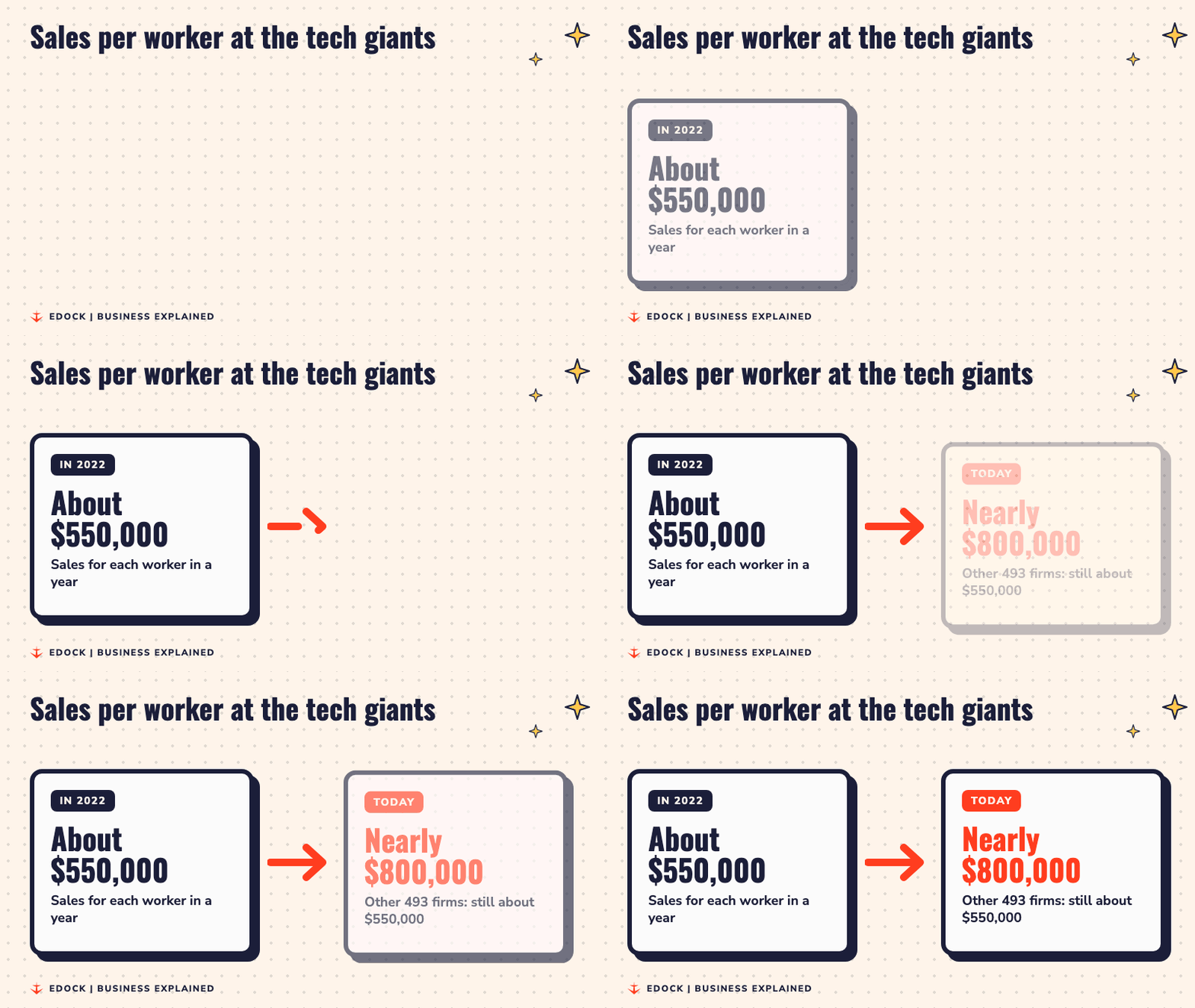
Business Insider read the charts closely. It reported that sales per employee at the tech companies rose from $550,000 in 2022 to nearly $800,000 today. For everyone else in the S&P 500, the figure has stayed around $550,000 for seven years. Profit margins for the other companies have stayed at about 10%.
Why are normal companies pulling back?
AI tools are often paid for in tokens. A token is a small piece of text, roughly part of a word. Companies pay for every token the AI reads or writes, a bit like paying a mobile bill by the minute.
Slok wrote that with no impact on profits, mainstream companies are starting to see token spending "not as a source of growth but as a cost center". A cost center is a part of a business that only spends money, like the electricity bill. He also wrote that normal companies do not need the latest AI model and are not willing to pay for it.
His deeper point is about judgment. "AI may be a great calculator, but in business, intelligence is mostly judgment," he wrote. He added that AI does not understand things like trust, culture and fairness, which shape how a company earns money over time.
The other side: the giants keep spending
The tech giants see it very differently. Take Meta, which owns Facebook, Instagram and WhatsApp. On 21 October, Meta reported that its revenue for July to September rose 26% to $64.6 billion. Mark Zuckerberg said in a statement, "Our investments are paying off."
Meta also spent $34.9 billion on capital expenditure in that quarter, up from $19.4 billion a year earlier. Capital expenditure, or capex, is money spent on big long-lasting things, like data centres and chips, instead of daily bills. It is like a stall owner buying a new cart rather than buying today's milk. Meta now expects to spend $135 billion to $145 billion on capex this year.
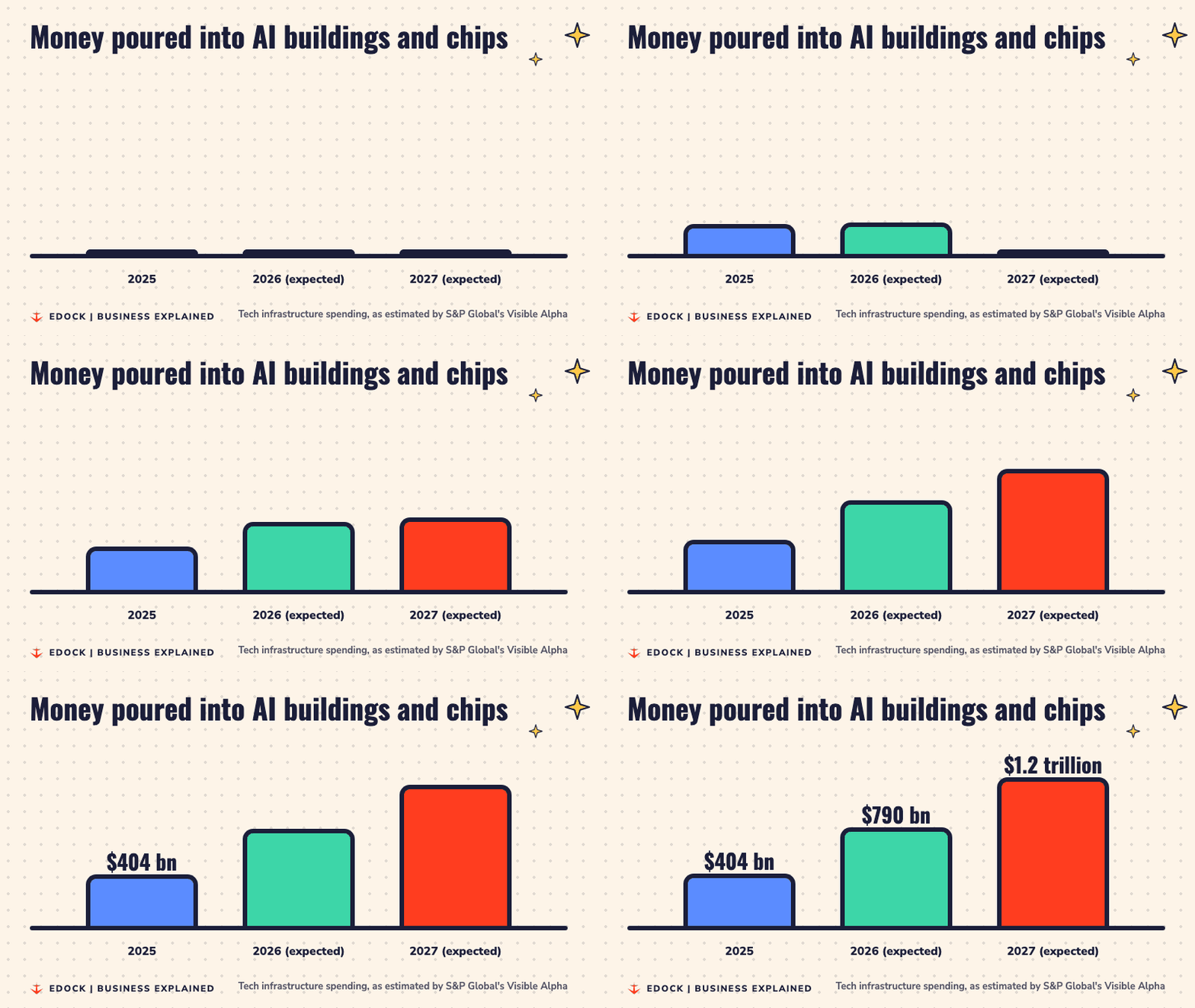
Across the tech world, the numbers are even bigger. Melissa Otto of S&P Global, quoted by Fortune, wrote that tech infrastructure spending is expected to reach $790 billion in 2026, almost double the $404 billion of 2025, and $1.2 trillion in 2027.
So both things are true at once. The builders of AI are earning more and spending more. The users of AI, the other 493 companies, have not shown the gains in their numbers yet. That is the gap Slok is pointing at. As he put it, "the AI story will be decided in the S&P 493, not the Mag 7."
He is not alone. TechCrunch noted that recent studies have also found AI has yet to deliver big productivity gains.
Here is Slok making a similar point in an interview with Yahoo Finance in September.
Why should a young Indian care?
Because India's IT services firms build software and AI systems for big companies around the world, including many in America. TCS, for example, announced deals this quarter with Porsche and the US electronics chain Best Buy.
On 8 October, TCS said its yearly AI revenue had reached $3.1 billion, up from $2.6 billion a quarter earlier. That is now more than 10% of all its revenue.
So AI projects are already real work for Indian engineers. The open question is the one Slok raises. If normal companies start to see AI as a bill rather than a money maker, they may become choosier about what they buy. If they find ways to earn more from it, demand could keep rising. Nobody knows yet which way it will go, and Apollo's note does not talk about India.
For a student or a first-time worker, the useful lesson is simple. Knowing how to use AI is good. Knowing how to show that it saved time or made money for a real business is even better, because that is exactly the proof companies are now looking for.
Sources
- Apollo: No Signs of AI Payoff Outside the Tech Sector (24 October 2026)
- TechCrunch: AI delivers zero financial payoff to most companies, Apollo economist says
- Business Insider: Apollo says AI has delivered zero financial payoff outside the tech industry
- Fortune: Meta's revenue rises to $64.6 billion as AI spending grows
- Moneycontrol: TCS annualised AI revenue reaches $3.1 billion
- Cover photo: New York Stock Exchange Facade 2015, by Jeffrey Zeldman, CC BY 2.0

You may republish this story under CC BY 4.0: credit Arshdeep Singh and link to this page.