Air India will fly Delhi to Osaka non-stop from February: why airlines bet on new routes
Four flights a week, 259 seats each, and a fast-growing crowd of Indians visiting Japan: the simple maths behind a new airline route.

Picture this. You fly into Tokyo, ride the fast trains to Kyoto and Osaka, eat your way through street food, and then you have to go all the way back to Tokyo just to catch your flight home. That long U-turn is about to get shorter for travellers from Delhi.
On 16 October 2026, Mint reported that Air India will start non-stop flights between New Delhi and Osaka's Kansai International Airport from 2 February 2027. The flights will run four times a week, and Air India will be the only airline flying this route without a stop.
It sounds like simple travel news. But behind it is a big business question: why does an airline open a new route at all, and how does a route make money?
What exactly is starting?
Here are the basics, from The Tribune and Mint:
- Flight AI360 leaves Delhi at 10.50 pm on Tuesdays, Thursdays, Saturdays and Sundays, and lands in Osaka at 9.50 am the next day.
- Flight AI359 leaves Osaka at 11.50 am on Mondays, Wednesdays, Fridays and Sundays, and reaches Delhi at 6.20 pm the same day.
- All times are local times.
- The plane is a Boeing 787-8 with 18 flat beds in Business Class and 241 seats in Economy Class.
Add those up and each flight has 259 seats. With four flights a week in each direction, that is 1,036 seats a week going to Osaka and 1,036 coming back.
Osaka will be Air India's second city in Japan. Today it flies to Tokyo's Haneda airport daily from Delhi and four times a week from Mumbai, Mint says.
This is not Air India's first time in Osaka, though. According to Live From A Lounge, the airline used to reach Osaka on a route that stopped in Hong Kong on the way, and that service ended in September 2019. The new flight is the first one that goes straight from Delhi.
Why open a new route at all?
Think of an airline route like a new samosa stall. Before you set one up at a college gate, you ask a simple question: will enough hungry students walk past every day?
For Air India, the "hungry students" are Indians who want to visit Japan. And that crowd is growing fast.
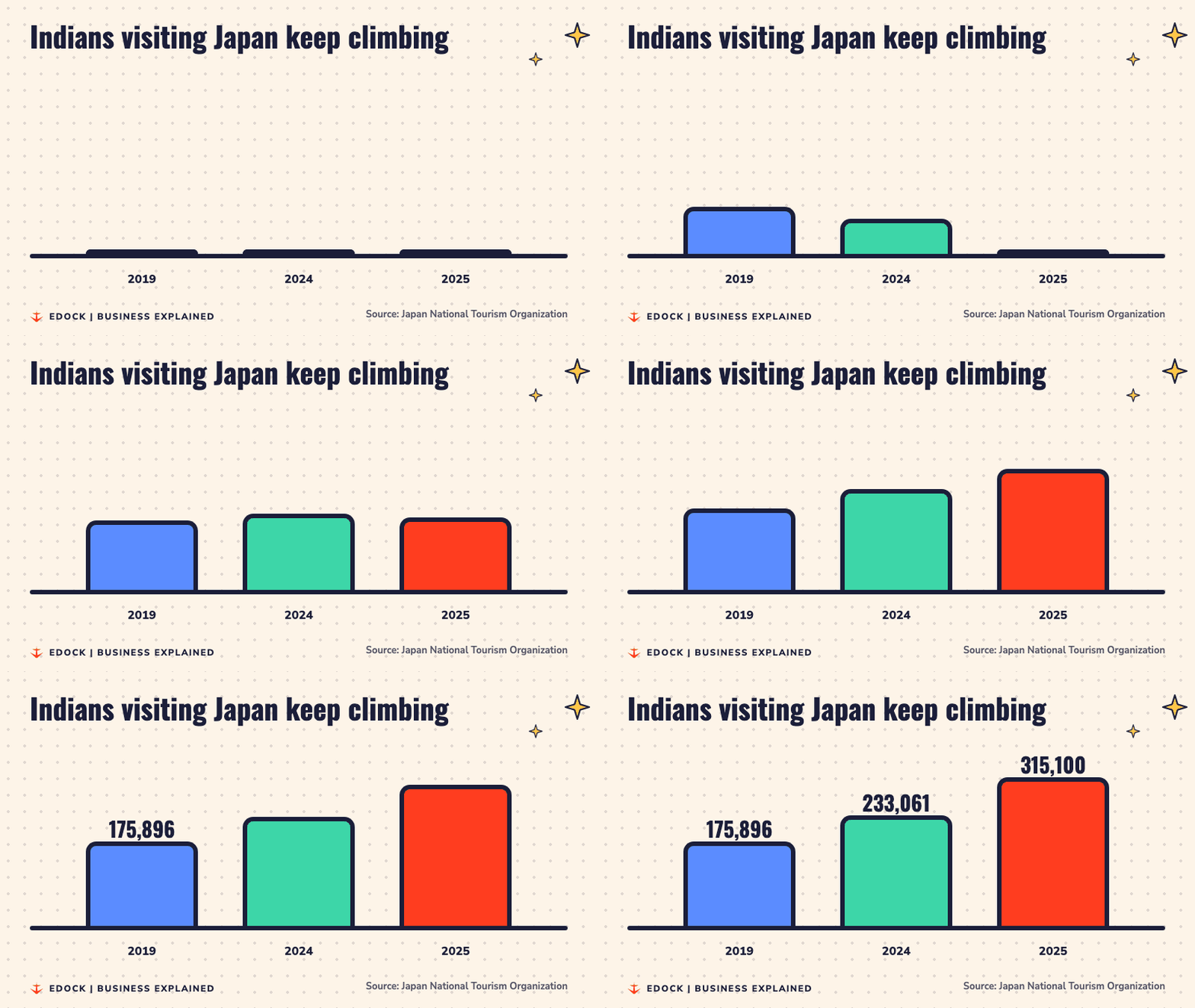
Data from the Japan National Tourism Organization (JNTO), the country's tourism office, shows that 315,100 visitors from India went to Japan in 2025. In 2024 the number was 233,061. That is a jump of about 35% in one year.
Go back further and the growth looks even bigger. In 2019, before the pandemic, the figure was 175,896, according to India Outbound, which reported JNTO's numbers. So 2025 was almost 80% higher than 2019.
Air India said this growth comes from rising interest in Japan's culture and food, along with growing business and people-to-people ties between the two countries, Mint reported.
Lots of room to grow
Here is the interesting part. Japan had 42,683,600 foreign visitors in 2025, the same JNTO table shows. Indians were just 315,100 of them. That is less than 1 out of every 100 visitors.
For an airline, a small share that is growing quickly can be more exciting than a big share that has stopped growing. It is like a cricket team spotting a young player who scores more runs every season. You want to sign him early.
JNTO's Delhi office has itself said that better air connections helped drive the record numbers, India Outbound reported. More flights make a trip easier, and an easier trip brings more travellers. Airlines hope for exactly that loop.
How does a route make money?
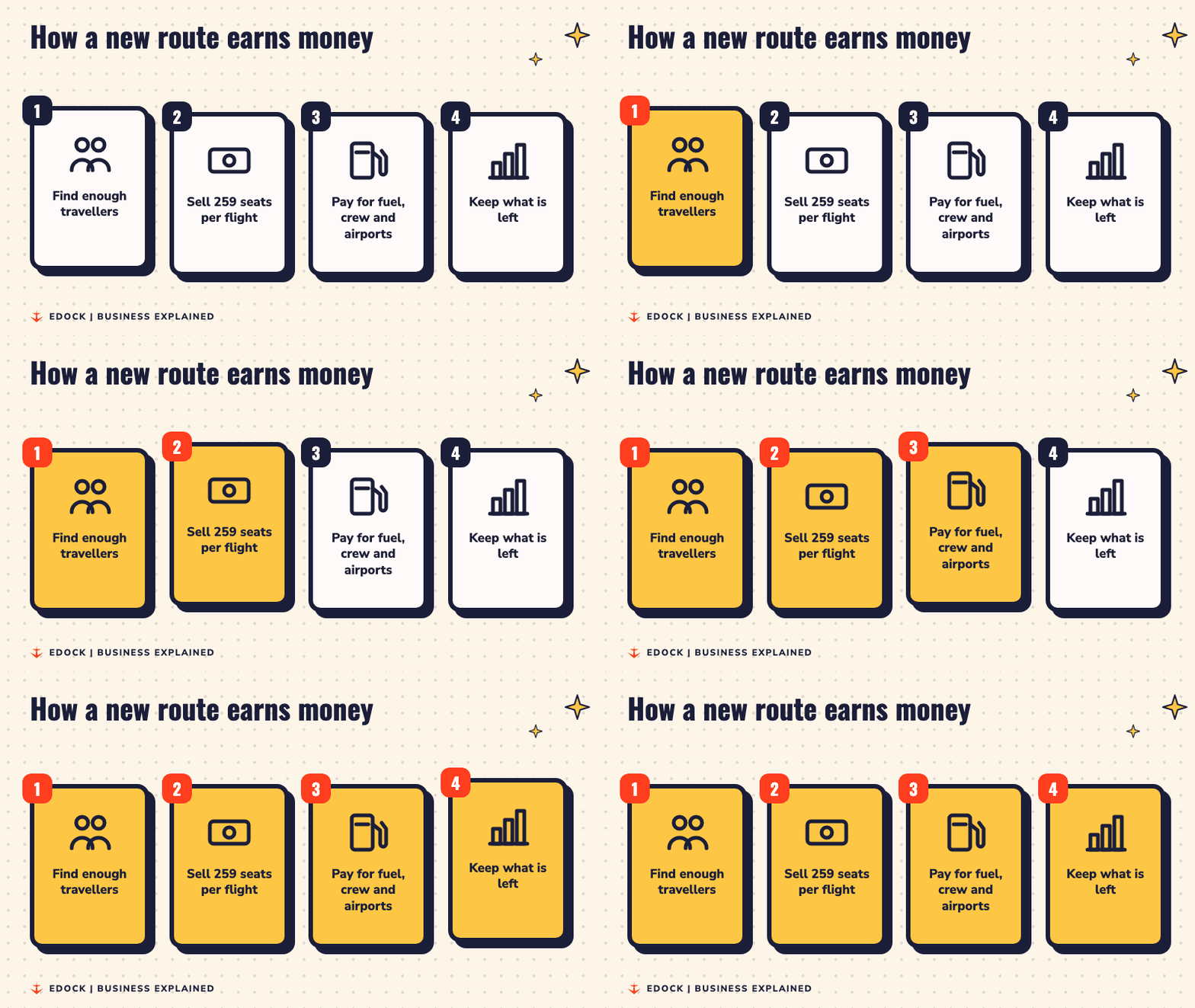
At its heart, a flight works like your pocket money. Money comes in, money goes out, and you hope something is left at the end of the month.
Money in comes mainly from tickets. The 18 Business Class beds usually sell for much more than Economy seats, so a few of them can matter a lot. It is like a chai stall where a few people buy the special masala chai with snacks, and those orders pay for a big part of the day.
Money out covers fuel, pilots and cabin crew, airport charges, food on board and looking after the plane. Many of these costs stay about the same whether the plane is full or half empty.
That is why airlines care about something called the load factor. It simply means how full the plane is. If 200 of 259 seats are sold, the load factor is about 77%. A fuller plane spreads the same costs over more paying travellers, so each seat becomes cheaper for the airline to fly.
Airlines often begin a new route with a few flights a week and add more once seats sell well. Think of it as opening your samosa stall three days a week first, then going daily once the queue gets long.
The Delhi connection trick
The flight is not only for people who live in Delhi. Mint says the timings are planned to give smooth connections to other places on Air India's domestic and international network.
This is the idea of a hub. A hub is a big airport where an airline gathers travellers from many cities and sends them onward. Someone from another Indian city can fly to Delhi first and then hop onto the Osaka flight. One plane to Osaka can be filled with people from many Indian cities, not just one.
Air India has also teamed up with Japanese airlines before. In 2024, it signed a codeshare deal with All Nippon Airways (ANA), Moneycontrol reported. A codeshare lets two airlines sell seats on each other's flights on a single ticket, a bit like two shops selling each other's products at their counters.
The Golden Route bonus
Many Indian visitors to Japan follow what is called the Golden Route: Tokyo, Kyoto and Osaka. An Air India spokesperson told The Tribune that the new flight lets passengers book open-jaw trips.
An open-jaw trip means you fly into one city and fly home from another. So you could land in Osaka, travel to Kyoto and Tokyo, and fly back to Delhi from Tokyo. No U-turn.

For Air India, this is smart business too. A traveller who can do the whole trip on one airline, in through Osaka and out through Tokyo, has less reason to book with someone else.
What to watch next
The first flight is still months away. The real test comes after February 2027: will the seats fill up, and will four flights a week grow into more?
The visitor numbers suggest strong interest. In May 2025 alone, 43,040 Indians visited Japan, the highest for any single month, India Outbound reported. If that kind of demand keeps rising, Osaka could become a lot more than a second stop on Air India's map of Japan.
Sources
- Planning a trip to Japan? Air India to start 1st-ever non-stop flights between Delhi and Osaka from February, Mint, 16 October 2026
- Air India to launch Delhi-Osaka flights from Feb 2, becoming only airline on route, The Tribune
- Air India to return to Osaka with new Delhi-Osaka non-stop service in February 2027, Live From A Lounge
- Number of visitor arrivals to Japan in December 2025, Japan National Tourism Organization
- Japan registers record 315,100 arrivals from India in 2025, India Outbound
- Air India enters into codeshare pact with Japan's All Nippon Airways, Moneycontrol, April 2024
- Cover photo: Sunset from a plane, by Paul-Vincent Roll, CC0

You may republish this story under CC BY 4.0: credit Pranav Sharma and link to this page.