Adani Power's profit more than doubles to Rs 7,019 crore, with help from one-time money
Version 1 of 1 saved 24 Oct 2026, 1:13 am IST · Chain line 186
As it was first published
Adani Power's profit more than doubles to Rs 7,019 crore, with help from one-time money
Selling more electricity helped, but old dues and a tax credit did a lot of the lifting. Here is how a coal power company earns and what to look for.
Picture a shop that earned Rs 2,906 crore in three months last year. This year, in the same three months, it earned Rs 7,019 crore. That is what happened at Adani Power, India's largest private company that makes electricity from coal.
On 23 October 2026, the company shared its results for July to September 2026. Its profit after tax rose 141.5%, from Rs 2,906.46 crore to Rs 7,019.32 crore. News reports rounded this to a 142% jump.
More than double sounds huge. But when you open the numbers, you find three different things pushing profit up. Only one of them is the regular, everyday business. Here is how to read it, step by step.
First, how does a power company make money?
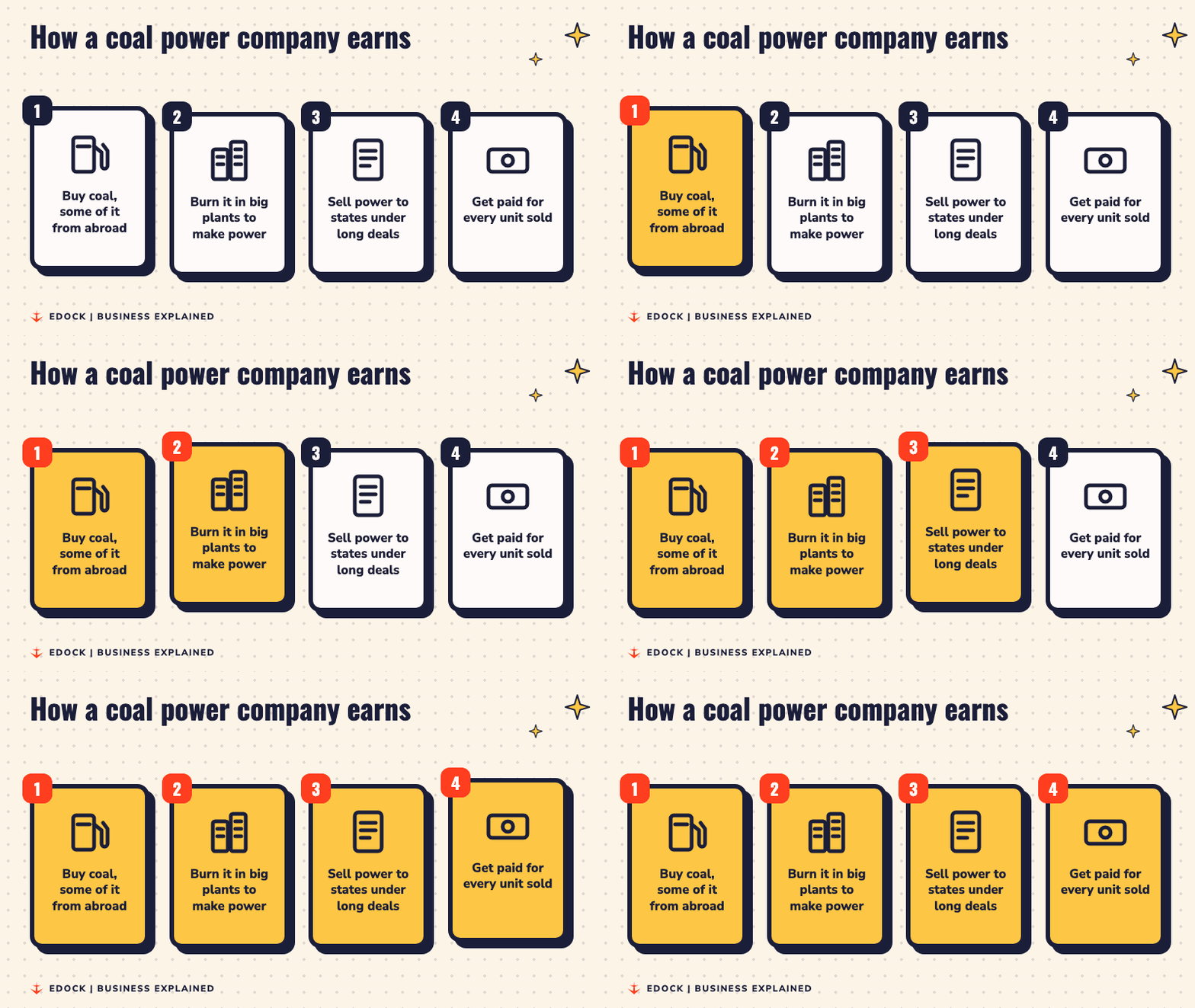
Think of a samosa stall. The owner buys potatoes and flour, fries the samosas and sells them by the plate. A coal power company works the same way. It buys coal, burns it in giant plants to make electricity, and sells that electricity. Instead of plates, it counts units. One unit is the power a 1,000 watt iron uses in one hour.
Adani Power sold 26.4 billion units in the quarter, up 11.5% from 23.7 billion units a year ago. A quarter is simply three months. Companies call this one Q2 FY27, the second quarter of the money year that ends in March 2027.
Most of its power goes out under a PPA, or power purchase agreement. This is a long contract with a buyer, usually a state power company, like a family that signs up for a tiffin service for years at a fixed rate. Sales under these deals grew 29.7% to 23.4 billion units, and the price per unit rose 12.7% to Rs 6.4.
The rest is sold in the merchant market, where power is bought and sold for the next day or even the next hour. It is like a fruit seller at a mandi: the price changes with demand. Here, Adani Power got Rs 7.2 a unit, 33.1% more than a year ago, though it sold 43% less power this way because more of it was tied up in longer deals.
Why did India need so much more power?
The company's own release says India's power demand grew 11.5% to 502 billion units in the quarter. It points to fast economic growth and a weak monsoon. The weak rains also meant hydro dams could make less power than usual. So coal filled the gap: coal and lignite plants gave 66% of India's power supply, up from 65% a year earlier.
Adani Power's plants also ran more. A plant's plant load factor, or PLF, tells you how much of the time it is running at full power. Think of the seats filled in a bus. Adani Power's PLF went from 62.8% to 70.1%. Its plants can make 18,150 MW at once. MW, or megawatt, measures how much power a plant can make at one moment, and 1,000 MW is one gigawatt (GW).
The three things that pushed profit up
1. The regular business grew. Leave out one-time items and the company's profit before tax from continuing business rose 32.5%, from Rs 3,297.68 crore to Rs 4,369.51 crore. Revenue from regular sales grew 29.8% to Rs 17,014.06 crore. This happened even though fuel cost 41.8% more, at Rs 10,229.38 crore, because imported coal landed 50% costlier. Its interest bill also fell 9.7% to Rs 760.23 crore.
2. Old money came in. The company counted Rs 2,422.25 crore of one-time income in this quarter. It came mainly from a revision in old energy charges under some PPAs. In simple words, the price for some power it sold in the past was revised, and the extra money was counted in this quarter. A year ago, this kind of money was only Rs 668.53 crore. It is like a friend paying back an old loan: nice, but it will not happen every month.
3. A tax gift. Normally a company pays tax out of its profit. This quarter, Adani Power's tax line was a credit of Rs 230.60 crore, against a tax bill of Rs 1,059.74 crore a year ago. That is why profit after tax ended up bigger than profit before tax. The filing included a Rs 1,211.43 crore reversal of tax expense for earlier years and a deferred tax credit of Rs 459.15 crore.

Let us check the sum
Add the regular profit before tax, Rs 4,369.51 crore, to the one-time income of Rs 2,422.25 crore. You get Rs 6,791.76 crore, which is exactly the reported profit before tax. Then the tax credit of Rs 230.60 crore is added on top, and a small Rs 3.04 crore loss from a company it partly owns is taken off. The result is Rs 7,019.32 crore.
So the smart way to read this result is in two lines. The everyday business grew about a third. The headline more than doubled because of old dues and tax.
What the CEO said
CEO S B Khyalia said that India's growing need for power is making the case for coal plants stronger, as The Economic Times reported. In the release, he said the company wants to lead in adding new coal power, as India needs 100 GW of new thermal capacity by 2032.
What comes next: lots of new plants
Adani Power is building 23,720 MW of new coal power capacity. That is more than its whole 18,150 MW today. If all of it is built, the total would be 41,870 MW.
- Korba Phase-II (1,320 MW): its first 660 MW unit is now linked to the power grid. The second unit should start in January to March 2027.
- Mahan Phase-II (1,600 MW): expected to be fully running in early FY28.
- Raipur Phase-II and Raigarh Phase-II (1,600 MW each): more than 65% done in under 30 months, and due in FY29.

It is also stepping beyond coal. It won a 25-year deal to supply 1,320 MW to Uttarakhand's power company. It was picked to take over GVK Energy, which runs the 330 MW Alaknanda hydro plant in Uttarakhand. And it signed a deal with Bhutan's Druk Green Power to build the 770 MW Chamkarchhu hydro project, with Adani Power holding 49%.
Building plants costs a lot. The company's total debt, money it has borrowed, rose to Rs 61,860.37 crore by 30 September 2026, from Rs 53,555.54 crore in March.
Why this matters to you
Every time you charge your phone or switch on a fan, some of that power likely came from a coal plant like these. This result also teaches a useful habit. When a company says profit doubled, look for the one-time items and the tax line. They can make a good quarter look like a great one. This post explains the numbers only. It is not advice to buy or sell any share.
Sources
- Adani Power: Adani Power announces Q2 FY27 results
- Business Standard: Adani Power Q2FY27 results, net profit rises 142% to Rs 7,019 crore
- The Economic Times: Adani Power CEO puts Q2 numbers in perspective
- Free Press Journal: Adani Power Q2 FY27 net profit jumps 142% to Rs 7,019 crore
- Cover photo: Mundra thermal power station, by Nizil Shah, CC BY-SA 1.0
