A robot hand that can feel just made its startup worth $1.45 billion
Version 1 of 1 saved 21 Oct 2026, 6:18 am IST · Chain line 104
As it was first published
A robot hand that can feel just made its startup worth $1.45 billion
Eka Robotics raised $150 million to build robot hands that use touch, not just sight. Here is what physical AI means, in simple words.
Picture a big, heavy robot arm rushing towards a raspberry. You expect a red mess. Instead, the arm slows down at the last moment, closes its fingers gently and lifts the fruit without a single squash. That small trick is part of why a young robot company is now valued at $1.45 billion.
The company is Eka Robotics. On 20 October 2026, TechCrunch reported that it had closed a $150 million Series A round at a $1.45 billion valuation, led by the investment firms a16z (Andreessen Horowitz) and F-Prime. Its big idea is simple to say and very hard to build: a robot hand that can feel.
First, what is "physical AI"?
Most AI you know lives inside a screen. A chatbot writes your essay. An app suggests your next song. None of it can pick up a cup of chai.
Physical AI is different. It means AI that controls machines and robots in the real world. Think of it as giving a robot a brain that can deal with real things: objects that slip, bend, roll or break.
That is harder than it sounds. A cricket ball, a soft tomato and a slippery bottle all need a different grip.
Why robots are bad at picking things up
Factory robots are great at doing the same move again and again, in the same place. But the real world is messy. As a16z puts it in its own note on the deal, parts move, materials bend and objects slip. So a lot of physical work, from packing to assembly, still needs human hands.
Your hand has a secret helper: touch. The same a16z note explains that touch is why you can hold an egg without crushing it, or tighten your grip the instant a glass starts to slip. You do not plan every move in advance. You feel, and you fix.
Eka's trick: let the robot feel
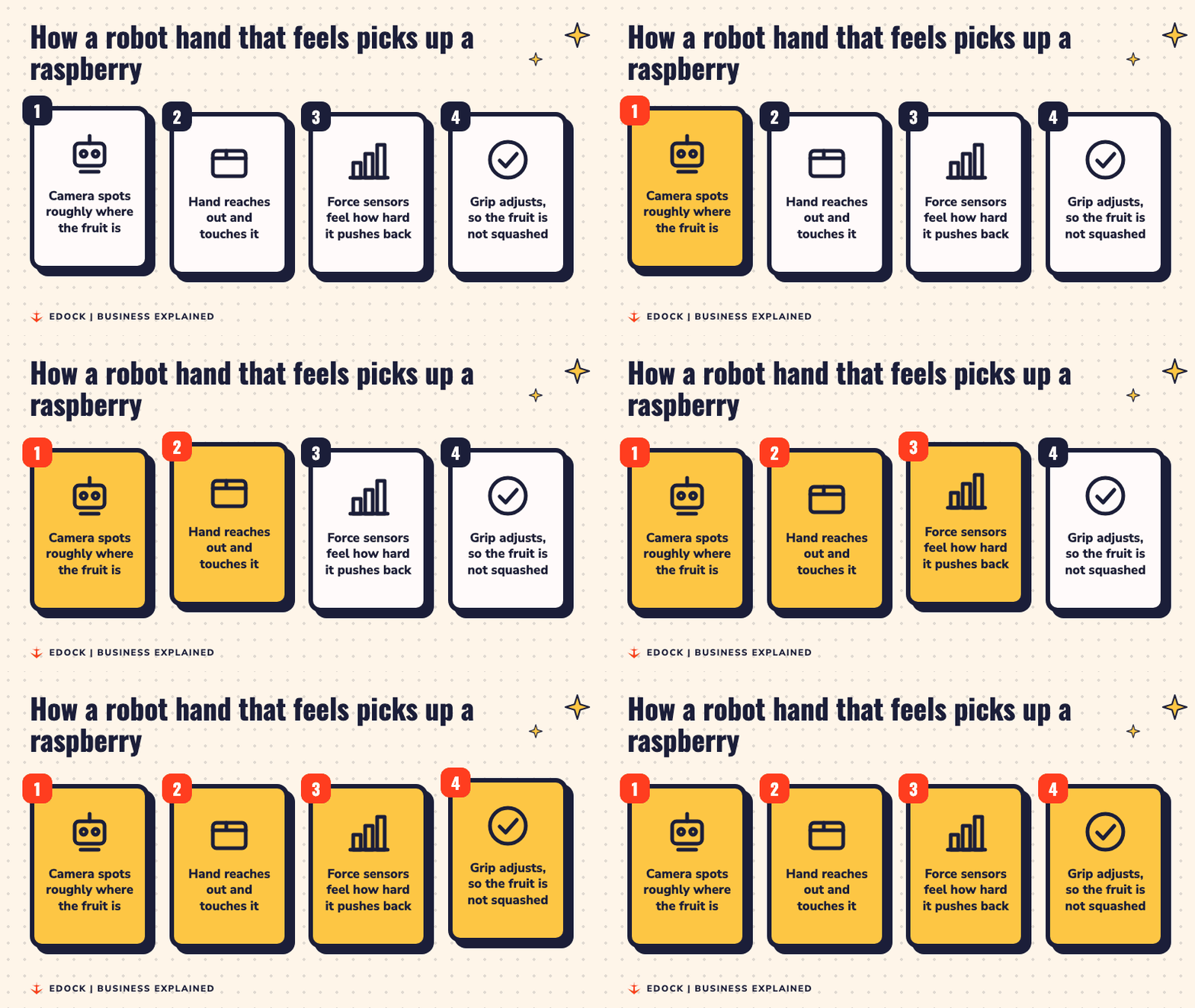
Many robot brains today are built on a vision-language-action model. That is a fancy name for AI that links what it sees and what it is told with what it does. Eka built something else: a vision-force-action model. Here, "force" means the push and pull the hand feels when it touches something.
Think of finding your phone in a dark room. Your eyes tell you roughly where the table is. Your fingers do the real work. Eka's robot works the same way. According to TechCrunch, the camera gives a rough idea of where the object is, while force sensors in its special hand handle the actual grasping.
Eka also had to design its own robot hand, more flexible than normal grippers and with more force sensors. It reacts to contact, which is why the raspberry survives.
How fast is this robot?
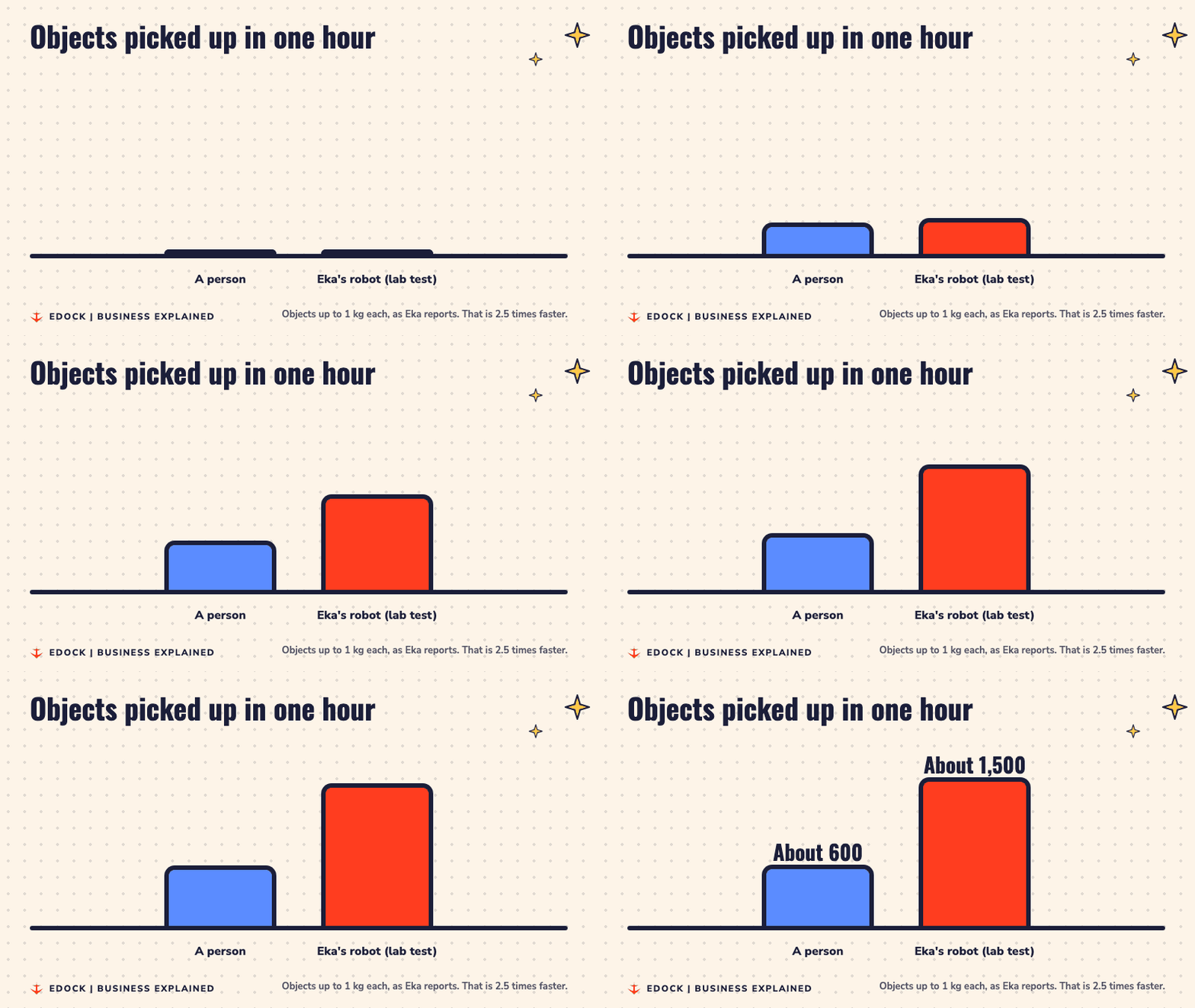
Here is the number that has robot experts talking. Eka says its robot can pick up about 1,500 objects weighing up to 1 kg in an hour, compared to about 600 for a human. It also says the robot picks objects correctly more than 95% of the time.
That is 2.5 times the human number, which matches what a16z wrote: up to 1,500 picks per hour in test settings, two and a half times faster than humans. Keep one thing in mind: these are the company's own test results, not yet results from a busy factory floor.
Kris Hauser, a robotics professor at the University of Illinois Urbana-Champaign, told TechCrunch the demo had a "wow factor" and that the robot adapted to many different objects without retraining. Another roboticist, from a top AI research group, compared seeing it to the moment robots first learned to walk reliably.
Practice in a video game world
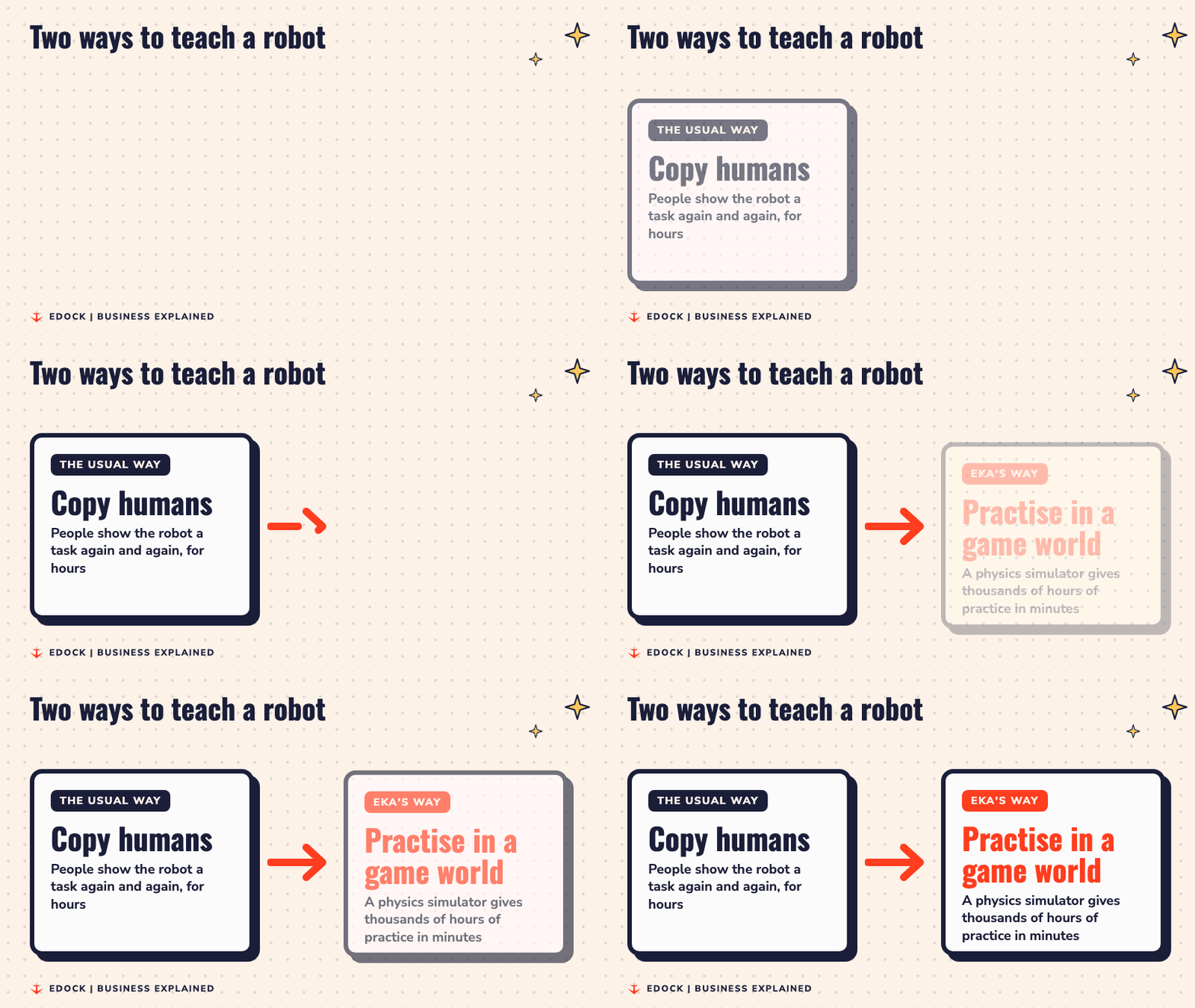
How do you teach a robot this skill? The usual way is to have people show the robot a task again and again, like a coach showing a batter the same shot. That takes a lot of human time.
Eka took another road. It uses a physics simulator, a computer world that copies how real objects push, slide and grip, almost like a very serious video game. Inside it, the robot learns by trial and error, which experts call reinforcement learning: try, fail, get a tiny reward for doing better, and try again. The founders say they can create thousands of hours of robot experience in minutes.
The a16z note points out a big upside. Virtual robots can practise millions of small changes in position and grip, and even learn from failures that humans rarely show. If this works at scale, robot experience can grow with computer power rather than human effort.
Want to hear the idea from the co-founder himself? Here is Pulkit Agrawal speaking about "force intelligence" and robot hands.
Who is behind Eka?
Eka was founded by MIT professor Pulkit Agrawal and former Google DeepMind researcher Tuomas Haarnoja. The two first met as graduate students at the University of California, Berkeley. Both are leading names in teaching robots through trial and error.
According to a16z, Agrawal runs the Improbable AI Lab at MIT CSAIL, and Haarnoja co-created Soft Actor-Critic, one of the key methods in modern reinforcement learning.
In this longer chat, Agrawal talks about two ways robots learn: copying people and learning by trial and error.
What do "Series A" and "$1.45 billion" mean?
A Series A is usually a startup's first big round of money from investors, after the early seed money. Think of a samosa stall that has proved people love its samosas. Now it raises money to open more stalls.
A valuation is what investors think the whole company is worth. TechCrunch calls Eka's $1.45 billion a post-money valuation, which means the value counted after the new $150 million came in. Simple maths: the new money is about one tenth of that value. Any company valued above $1 billion is called a unicorn, and Eka has now crossed into unicorn territory.
Eka is not alone. In the same news cycle, Arda, a startup building AI for factory engineers, raised $230 million at a $1.5 billion valuation.
What still has to be proven
A great demo is not a great business yet. Eka is running secret pilot projects with industrial customers in pick-and-place work and wire handling. A pilot is a small trial run, like a free sample before a big order.
Hauser told TechCrunch the real test is a robot running on an assembly line for a whole year without breaking. He also asked whether the method works for tasks beyond picking things up and putting them down.
Then there is toughness. Eka's gripper costs less than $1,000 and is rated for 5 million duty cycles, meaning 5 million grab-and-release moves. Standard industrial arms reach 20 million, and that is Eka's goal. So the hand has to become four times tougher.
Even a16z, which led the round, says that keeping this speed through full factory shifts is the next test. Agrawal's plan is to start small: win in two areas, picking and placing, and wire handling, and then grow from there.
Why this matters to you
Chatbots changed how people write and study. Physical AI could change how things get packed, sorted and built. If robots learn to feel, the warehouse that packs your online order or the factory that makes your phone could look very different in a few years.
Sources
- Eka is worth $1.45B thanks to a physical AI model that has experts raving, TechCrunch, 20 October 2026
- Investing in Eka Robotics, a16z
- Physical A.I.: Arda and Eka raise a combined $380 million, Trending Topics
- Eka Robotics hits $1.45B valuation with physical AI breakthrough, TechBuzz
- Video: Force Intelligence: A Path to General Dexterity by Pulkit Agrawal, Foxglove, YouTube
- Video: Pulkit Agrawal (MIT and EKA Robotics): On RL and IL, YouTube
- Cover photo: Factory Automation Robotics Palettizing Bread, by KUKA Roboter GmbH, Bachmann, public domain
